Group A · Match 08
ELA (Henry David Thoreau) vs ARTS (Dante Alighieri)
Result 1-1. Outcome: Draw.
Realtime Call
-
Turn 1. Knight asks: "If this line is valid, what would it imply for the other side to justify now?"
\nThe inquiry keeps moving.
-
Turn 2. Pass. "Or ere that work engag'd me, I did hold Christ's nature merely human, with such faith Contented."
\nThe inquiry keeps moving.
-
Turn 3. Bishop answers: "It is beginning to reach down from observation to experimental analysis, and from experimental analysis to grasp of principle."
\nThe inquiry keeps moving.
-
Turn 4. Bishop answers: "There had been another change, though, that was significant enough and that was in the colors."
\nThe move answers pressure.
-
Turn 5. Bishop answers: "Julian Huxley framed this well; the inference is that we should move here."
\nThe move answers pressure.
-
Turn 6. Knight asks: "What assumption are we testing if Isaac Asimov keeps the focus here?"
\nThe challenge gives the next answer real work to do.
-
Turn 7. Bishop answers: "In pre-human evolution, the blind chances of variation and the blind sifting of natural selection have directed the course of evolution and of progress."
\nThe challenge gives the next answer real work to do.
-
Turn 8. Advance. Queen Emily Dickinson develops the line.
\nThe inquiry keeps moving.
-
Turn 9. Pass. Julian Huxley releases to Queen Buddha, who re-centers the question.
\nThe move answers pressure.
-
Turn 10. Bishop answers: "Certainly, it is heaven upon earth, to have a man's mind move in charity, rest in providence, and turn upon the poles of truth."
\nThe inquiry keeps moving.
-
Turn 11. Bishop answers: "That means the stronger reading is likely in this direction."
\nThe inquiry keeps moving.
-
Turn 12. Advance. Queen Emily Dickinson develops the line.
\nThe inquiry keeps moving.
-
Turn 13. Bishop answers: "That means the stronger reading is likely in this direction under pressure."
\nThe challenge gives the next answer real work to do.
-
Turn 14. Advance. "It answer to his question none return'd, But of our country and our kind of life Demanded."
\nThe inquiry keeps moving.
-
Turn 15. Advance. Stephen Jay Gould releases to Queen Buddha, who develops the line.
\nThe move answers pressure.
-
Turn 16. Bishop answers: "The reason was, because the religion of the heathen, consisted rather in rites and ceremonies, than in any constant belief."
\nThe inquiry keeps moving.
-
Turn 17. Challenge. Checked Queen Buddha tests the opposing line.
\nThe challenge gives the next answer real work to do.
-
Turn 18. Bishop answers: "Good Lord, what man in Robotics has not been investigated and cleared to death by your people."
\nThe move answers pressure.
-
Turn 19. Knight asks: "If this line is valid, what would it imply for the other side to justify now?"
\nThe challenge gives the next answer real work to do.
-
Turn 20. Advance. "That ignoble life, Which made them vile before, now makes them dark, And to all knowledge indiscernible."
\nThe move answers pressure.
-
Turn 21. Bishop answers: "That means the stronger reading is likely in this direction under pressure."
\nThe score moves to 1-0.
-
Turn 22. Bishop answers: "Elias Lynn was a large man, almost charmingly homely, with pale blue eyes that bulged a bit."
\nThe move answers pressure.
-
Turn 23. Knight asks: "If this line is valid, what would it imply for the other side to justify now?"
\nThe challenge gives the next answer real work to do.
-
Turn 24. Advance. Isaac Asimov releases to Queen Emily Dickinson, who develops the line.
\nThe move answers pressure.
-
Turn 25. Knight asks: "If this line is valid, what would it imply for the other side to justify now?"
\nThe challenge gives the next answer real work to do.
-
Turn 26. Pass. "Thou arguest; if the good intent remain; What reason that another's violence Should stint the measure of my fair desert".
\nThe move answers pressure.
-
Turn 27. Bishop answers: "The one, that is to say, remained in essence a quantitative change so far as concerns the real life of man; the other can be a qualitative change."
\nThe move answers pressure.
-
Turn 28. Advance. "Or ere that work engag'd me, I did hold Christ's nature merely human, with such faith Contented."
\nThe move answers pressure.
-
Turn 29. Advance. Julian Huxley releases to King Henry David Thoreau, who develops the line.
\nThe move answers pressure.
-
Turn 30. Pass. Queen Emily Dickinson re-centers the question.
\nThe inquiry keeps moving.
-
Turn 31. Challenge. Checked King Henry David Thoreau tests the opposing line.
\nThe challenge gives the next answer real work to do.
-
Turn 32. Claim. Checked Queen Emily Dickinson presses a claim.
\nThe score moves to 1-1.
-
Turn 33. Bishop answers: "Men are educated to be self-reliant and enterprising in the details of life, but dependent, unreflective, _laissez-faire_ about life itself."
\nThe challenge gives the next answer real work to do.
-
Turn 34. Bishop answers: "I have enlarged them, both in Number, and Weight; So that they are indeed a New Worke."
\nThe inquiry keeps moving.
-
Turn 35. Bishop answers: "Julian Huxley framed this well; the inference is that we should move here."
\nThe challenge gives the next answer real work to do.
-
Turn 36. Bishop answers: "Tiberius in dissimulation; as Tacitus saith of him, Jam Tiberium vires et corpus, non dissimulatio, deserebant."
\nThe challenge gives the next answer real work to do.
-
Turn 37. Bishop answers: "That means the stronger reading is likely in this direction under pressure."
\nThe move answers pressure.
-
Turn 38. Bishop answers: "Over there, They were "We" (in the appropriate language) and We were "They." Scarcely anyone gave thought to such things any more."
\nThe challenge gives the next answer real work to do.
-
Turn 39. Advance. Stephen Jay Gould releases to Queen Buddha, who develops the line.
\nThe move answers pressure.
-
Turn 40. Save. Queen Emily Dickinson is denied closure.
\nClosure is delayed at 1-1.
-
Turn 41. Knight asks: "If this line is valid, what would it imply for the other side to justify now?"
\nThe challenge gives the next answer real work to do.
-
Turn 42. Bishop answers: "There had been another change, though, that was significant enough and that was in the colors."
\nThe challenge gives the next answer real work to do.
-
Turn 43. Knight asks: "If this line is valid, what would it imply for the other side to justify now?"
\nThe move answers pressure.
-
Turn 44. Bishop answers: "Certainly, it is heaven upon earth, to have a man's mind move in charity, rest in providence, and turn upon the poles of truth."
\nClosure is delayed at 1-1.
-
Turn 45. Knight asks: "If this line is valid, what would it imply for the other side to justify now?"
\nThe challenge gives the next answer real work to do.
-
Turn 46. Advance. "It answer to his question none return'd, But of our country and our kind of life Demanded."
\nThe move answers pressure.
-
Turn 47. Knight asks: "If this line is valid, what would it imply for the other side to justify now?"
\nThe move answers pressure.
-
Turn 48. Bishop answers: "The reason was, because the religion of the heathen, consisted rather in rites and ceremonies, than in any constant belief."
\nThe move answers pressure.
Board Record
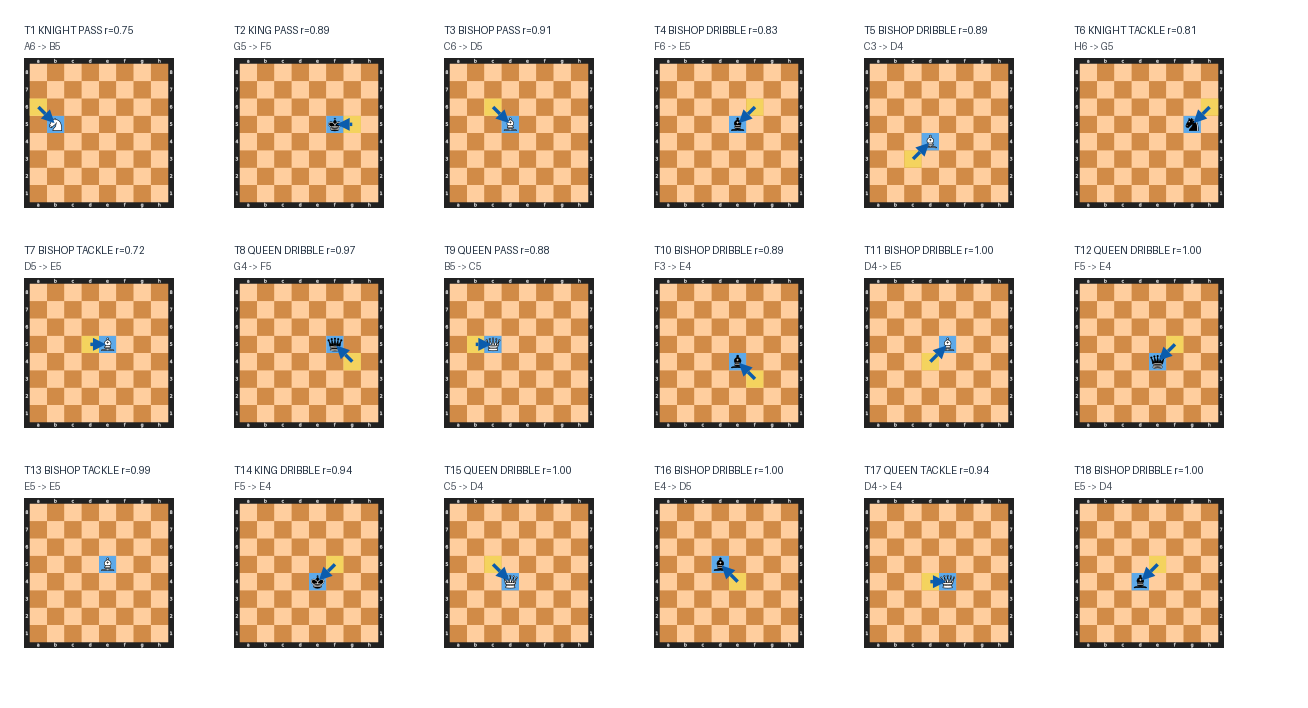
Match Shape
Discourse B (0.859); aesthetic B (0.863); repetition 0.274. Move mix: 7 pass, 22 advance, 15 challenge, 2 claim, 2 save.
- Turn 6
Isaac Asimov releases to Knight James Baldwin, who tests the opposing line. - Turn 21
John Maynard Smith releases to Bishop Stephen Jay Gould, who presses a claim. - Turn 32
Checked Queen Emily Dickinson presses a claim. - Turn 40
Queen Emily Dickinson is denied closure.
Full Call Sheet
| Turn | Score | Action | Call | Relevance |
|---|---|---|---|---|
| 1 | 0-0 | Pass | Knight John Maynard Smith re-centers the question. | 0.749 |
| 2 | 0-0 | Pass | King Dante Alighieri re-centers the question. | 0.886 |
| 3 | 0-0 | Pass | Bishop Julian Huxley re-centers the question. | 0.906 |
| 4 | 0-0 | Advance | Dante Alighieri releases to Bishop Isaac Asimov, who develops the line. | 0.827 |
| 5 | 0-0 | Advance | Julian Huxley releases to Bishop Stephen Jay Gould, who develops the line. | 0.887 |
| 6 | 0-0 | Challenge | Isaac Asimov releases to Knight James Baldwin, who tests the opposing line. | 0.814 |
| 7 | 0-0 | Challenge | Stephen Jay Gould releases to Bishop Julian Huxley, who tests the opposing line. | 0.717 |
| 8 | 0-0 | Advance | Queen Emily Dickinson develops the line. | 0.971 |
| 9 | 0-0 | Pass | Julian Huxley releases to Queen Buddha, who re-centers the question. | 0.876 |
| 10 | 0-0 | Advance | Bishop Francis Bacon develops the line. | 0.894 |
| 11 | 0-0 | Advance | Bishop Stephen Jay Gould develops the line. | 1.000 |
| 12 | 0-0 | Advance | Queen Emily Dickinson develops the line. | 1.000 |
| 13 | 0-0 | Challenge | Checked Bishop Stephen Jay Gould tests the opposing line. | 0.990 |
| 14 | 0-0 | Advance | King Dante Alighieri develops the line. | 0.945 |
| 15 | 0-0 | Advance | Stephen Jay Gould releases to Queen Buddha, who develops the line. | 1.000 |
| 16 | 0-0 | Advance | Bishop Francis Bacon develops the line. | 1.000 |
| 17 | 0-0 | Challenge | Checked Queen Buddha tests the opposing line. | 0.937 |
| 18 | 0-0 | Advance | Francis Bacon releases to Bishop Isaac Asimov, who develops the line. | 1.000 |
| 19 | 0-0 | Challenge | Buddha releases to Knight John Maynard Smith, who tests the opposing line. | 0.895 |
| 20 | 0-0 | Advance | Isaac Asimov releases to King Dante Alighieri, who develops the line. | 0.870 |
| 21 | 1-0 | Claim | John Maynard Smith releases to Bishop Stephen Jay Gould, who presses a claim. | 1.000 |
| 22 | 1-0 | Advance | Dante Alighieri releases to Bishop Isaac Asimov, who develops the line. | 0.972 |
| 23 | 1-0 | Challenge | Knight John Maynard Smith tests the opposing line. | 1.000 |
| 24 | 1-0 | Advance | Isaac Asimov releases to Queen Emily Dickinson, who develops the line. | 0.990 |
| 25 | 1-0 | Challenge | Checked Knight John Maynard Smith tests the opposing line. | 0.999 |
| 26 | 1-0 | Pass | Emily Dickinson releases to King Dante Alighieri, who re-centers the question. | 1.000 |
| 27 | 1-0 | Pass | John Maynard Smith releases to Bishop Julian Huxley, who re-centers the question. | 0.885 |
| 28 | 1-0 | Advance | Checked King Dante Alighieri develops the line. | 0.964 |
| 29 | 1-0 | Advance | Julian Huxley releases to King Henry David Thoreau, who develops the line. | 0.910 |
| 30 | 1-0 | Pass | Queen Emily Dickinson re-centers the question. | 1.000 |
| 31 | 1-0 | Challenge | Checked King Henry David Thoreau tests the opposing line. | 1.000 |
| 32 | 1-1 | Claim | Checked Queen Emily Dickinson presses a claim. | 1.000 |
| 33 | 1-1 | Challenge | Henry David Thoreau releases to Bishop Julian Huxley, who tests the opposing line. | 0.853 |
| 34 | 1-1 | Advance | Bishop Francis Bacon develops the line. | 0.960 |
| 35 | 1-1 | Challenge | Julian Huxley releases to Bishop Stephen Jay Gould, who tests the opposing line. | 0.834 |
| 36 | 1-1 | Challenge | Checked Bishop Francis Bacon tests the opposing line. | 1.000 |
| 37 | 1-1 | Advance | Checked Bishop Stephen Jay Gould develops the line. | 1.000 |
| 38 | 1-1 | Challenge | Francis Bacon releases to Bishop Isaac Asimov, who tests the opposing line. | 1.000 |
| 39 | 1-1 | Advance | Stephen Jay Gould releases to Queen Buddha, who develops the line. | 0.907 |
| 40 | 1-1 | Save | Queen Emily Dickinson is denied closure. | 0.833 |
| 41 | 1-1 | Challenge | Buddha releases to Knight John Maynard Smith, who tests the opposing line. | 0.942 |
| 42 | 1-1 | Challenge | Emily Dickinson releases to Bishop Isaac Asimov, who tests the opposing line. | 0.892 |
| 43 | 1-1 | Advance | Checked Knight John Maynard Smith develops the line. | 1.000 |
| 44 | 1-1 | Save | Bishop Francis Bacon is denied closure. | 0.910 |
| 45 | 1-1 | Challenge | Checked Knight John Maynard Smith tests the opposing line. | 0.911 |
| 46 | 1-1 | Advance | Francis Bacon releases to King Dante Alighieri, who develops the line. | 1.000 |
| 47 | 1-1 | Advance | Checked Knight John Maynard Smith develops the line. | 0.833 |
| 48 | 1-1 | Advance | Dante Alighieri releases to Bishop Francis Bacon, who develops the line. | 0.974 |