Group A · Match 04
NAT (Albert Einstein) vs HUM (Miguel de Cervantes)
Result 1-0. Outcome: NAT (Albert Einstein).
Realtime Call
-
Turn 1. Pass. "It is only with reluctance that man's desire for knowledge endures a dualism of this kind."
\nThe inquiry keeps moving.
-
Turn 2. Pass. "Buildings and ramps and open-air machinery; the city was sealed in a protective dust-proof envelope."
\nThe inquiry keeps moving.
-
Turn 3. Bishop answers: "Naturalists continually refer to external conditions, such as climate, food, etc., as the only possible cause of variation."
\nThe move answers pressure.
-
Turn 4. Knight asks: "What assumption are we testing if knight keeps the focus here?"
\nThe inquiry keeps moving.
-
Turn 5. Bishop answers: "From the strong principle of inheritance, any selected variety will tend to propagate its new and modified form."
\nThe challenge gives the next answer real work to do.
-
Turn 6. Pass. King Miguel de Cervantes re-centers the question.
\nThe inquiry keeps moving.
-
Turn 7. Bishop answers: "In the last chapter I shall give a brief recapitulation of the whole work, and a few concluding remarks."
\nThe move answers pressure.
-
Turn 8. Advance. "We have all their planets except the inner Orion string--not that they're worth much, but it's the principle of the thing."
\nThe inquiry keeps moving.
-
Turn 9. Bishop answers: "I need not enumerate the actual results which the last century gained by this work."
\nThe move answers pressure.
-
Turn 10. Challenge. "Tony noticed the Pas-udeti's sudden change of expression, and he was puzzled."
\nThe challenge gives the next answer real work to do.
-
Turn 11. Advance. "How was unity to be preserved in his comprehension of the forces of nature".
\nThe move answers pressure.
-
Turn 12. Bishop answers: "I can defend it on this basis, and that is why this answer matters."
\nThe inquiry keeps moving.
-
Turn 13. Bishop answers: "He had probably never dipped very deep in the latter subject, and that strengthened our doubts."
\nThe move answers pressure.
-
Turn 14. Bishop answers: "I can defend it on this basis, and that is why this answer matters."
\nThe move answers pressure.
-
Turn 15. Advance. Hermann von Helmholtz releases to Queen David Bohm, who develops the line.
\nThe move answers pressure.
-
Turn 16. Bishop answers: "I can defend it on this basis, and that is why this answer matters."
\nThe challenge gives the next answer real work to do.
-
Turn 17. Bishop answers: "Any change in the embryo or larva will almost certainly entail changes in the mature animal."
\nThe inquiry keeps moving.
-
Turn 18. Bishop answers: "So the core point is this: the line from F3->G4 is the better constraint."
\nThe move answers pressure.
-
Turn 19. Bishop answers: "We now know that many of these hypotheses, which found favour in their day, far overshot the mark."
\nThe move answers pressure.
-
Turn 20. Advance. "The hot dust lapped at his ankles; he automatically moved his feet and slapped at his trousers."
\nThe inquiry keeps moving.
-
Turn 21. Challenge. Hermann von Helmholtz releases to Queen David Bohm, who tests the opposing line.
\nThe challenge gives the next answer real work to do.
-
Turn 22. Advance. "Buildings and ramps and open-air machinery; the city was sealed in a protective dust-proof envelope."
\nThe move answers pressure.
-
Turn 23. Save. "Thus the endeavour toward a unified view of the nature of forces leads to the hypothesis of an ether."
\nClosure is delayed at 0-0.
-
Turn 24. Challenge. "We have all their planets except the inner Orion string--not that they're worth much, but it's the principle of the thing."
\nThe challenge gives the next answer real work to do.
-
Turn 25. Bishop answers: "Owing to the Reformation, intellectual life had lost its old stability and cohesion; everything appeared in a new light, and new questions arose."
\nThe challenge gives the next answer real work to do.
-
Turn 26. Bishop answers: "That means the stronger reading is likely in this direction under pressure."
\nThe move answers pressure.
-
Turn 27. Advance. Queen David Bohm develops the line.
\nThe inquiry keeps moving.
-
Turn 28. Bishop answers: "I can defend it on this basis, and that is why this answer matters."
\nThe move answers pressure.
-
Turn 29. Advance. "It appeared beyond question that light must be interpreted as a vibratory process in an elastic, inert medium filling up universal space."
\nThe move answers pressure.
-
Turn 30. Bishop answers: "I can defend it on this basis, and that is why this answer matters."
\nThe move answers pressure.
-
Turn 31. Challenge. "It is only with reluctance that man's desire for knowledge endures a dualism of this kind."
\nThe challenge gives the next answer real work to do.
-
Turn 32. Bishop answers: "I can defend it on this basis, and that is why this answer matters."
\nThe move answers pressure.
-
Turn 33. Knight asks: "Natural philosophy, which preceded all exact observation in antiquity, is a natural, but not unfrequently ill-directed, effort of reason?"
\nThe inquiry keeps moving.
-
Turn 34. Advance. James Joyce releases to King Miguel de Cervantes, who develops the line.
\nThe move answers pressure.
-
Turn 35. Advance. Queen David Bohm develops the line.
\nThe inquiry keeps moving.
-
Turn 36. Knight asks: "What assumption are we testing if Miguel de Cervantes keeps the focus here?"
\nThe move answers pressure.
-
Turn 37. Bishop answers: "I need not enumerate the actual results which the last century gained by this work."
\nThe move answers pressure.
-
Turn 38. Advance. Machado de Assis releases to King Miguel de Cervantes, who develops the line.
\nThe move answers pressure.
-
Turn 39. Challenge. Queen David Bohm tests the opposing line.
\nThe challenge gives the next answer real work to do.
-
Turn 40. Knight asks: "What assumption are we testing if knight keeps the focus here?"
\nThe challenge gives the next answer real work to do.
-
Turn 41. Save. Checked Queen David Bohm is denied closure.
\nClosure is delayed at 0-0.
-
Turn 42. Bishop answers: "I can defend it on this basis, and that is why this answer matters."
\nClosure is delayed at 0-0.
-
Turn 43. Advance. Checked Queen David Bohm develops the line.
\nThe move answers pressure.
-
Turn 44. Knight asks: "What assumption are we testing if James Joyce keeps the focus here?"
\nThe challenge gives the next answer real work to do.
-
Turn 45. Challenge. Checked Queen David Bohm tests the opposing line.
\nThe challenge gives the next answer real work to do.
-
Turn 46. Knight asks: "What assumption are we testing if knight keeps the focus here?"
\nThe move answers pressure.
-
Turn 47. Bishop answers: "He had probably never dipped very deep in the latter subject, and that strengthened our doubts."
\nThe score moves to 1-0.
-
Turn 48. Knight asks: "What assumption are we testing if knight keeps the focus here?"
\nThe challenge gives the next answer real work to do.
Board Record
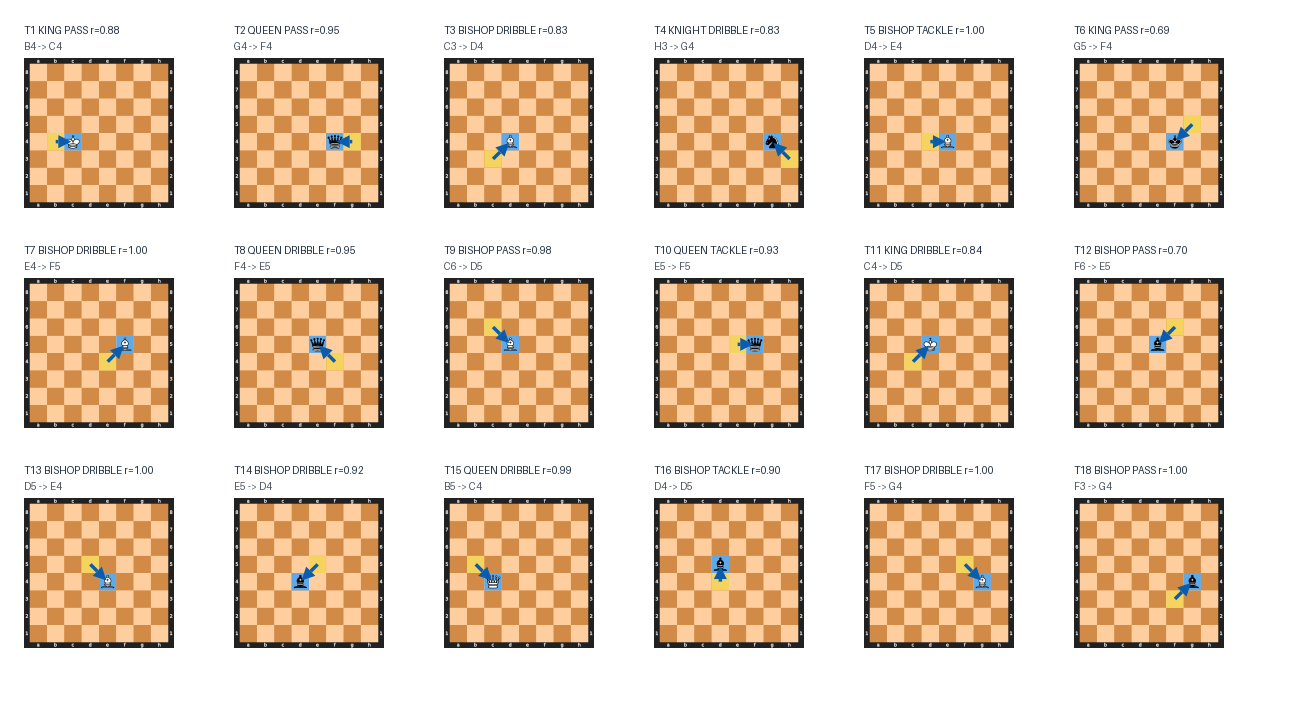
Match Shape
Discourse B (0.816); aesthetic B (0.851); repetition 0.198. Move mix: 10 pass, 22 advance, 12 challenge, 1 claim, 3 save.
- Turn 5
Checked Bishop Charles Darwin tests the opposing line. - Turn 7
Checked Bishop Charles Darwin develops the line. - Turn 23
David Bohm releases to King Albert Einstein, who is denied closure. - Turn 47
David Bohm releases to Bishop Hermann von Helmholtz, who presses a claim.
Full Call Sheet
| Turn | Score | Action | Call | Relevance |
|---|---|---|---|---|
| 1 | 0-0 | Pass | King Albert Einstein re-centers the question. | 0.881 |
| 2 | 0-0 | Pass | Queen Philip K. Dick re-centers the question. | 0.946 |
| 3 | 0-0 | Advance | Albert Einstein releases to Bishop Charles Darwin, who develops the line. | 0.832 |
| 4 | 0-0 | Advance | Knight Mark Twain develops the line. | 0.831 |
| 5 | 0-0 | Challenge | Checked Bishop Charles Darwin tests the opposing line. | 1.000 |
| 6 | 0-0 | Pass | King Miguel de Cervantes re-centers the question. | 0.687 |
| 7 | 0-0 | Advance | Checked Bishop Charles Darwin develops the line. | 1.000 |
| 8 | 0-0 | Advance | Queen Philip K. Dick develops the line. | 0.954 |
| 9 | 0-0 | Pass | Charles Darwin releases to Bishop Hermann von Helmholtz, who re-centers the question. | 0.981 |
| 10 | 0-0 | Challenge | Checked Queen Philip K. Dick tests the opposing line. | 0.927 |
| 11 | 0-0 | Advance | Hermann von Helmholtz releases to King Albert Einstein, who develops the line. | 0.842 |
| 12 | 0-0 | Pass | Bishop James Joyce re-centers the question. | 0.698 |
| 13 | 0-0 | Advance | Albert Einstein releases to Bishop Hermann von Helmholtz, who develops the line. | 1.000 |
| 14 | 0-0 | Advance | Checked Bishop James Joyce develops the line. | 0.916 |
| 15 | 0-0 | Advance | Hermann von Helmholtz releases to Queen David Bohm, who develops the line. | 0.990 |
| 16 | 0-0 | Challenge | Checked Bishop James Joyce tests the opposing line. | 0.896 |
| 17 | 0-0 | Advance | Bishop Charles Darwin develops the line. | 1.000 |
| 18 | 0-0 | Pass | James Joyce releases to Bishop Richard Lovelace, who re-centers the question. | 1.000 |
| 19 | 0-0 | Advance | Charles Darwin releases to Bishop Hermann von Helmholtz, who develops the line. | 0.989 |
| 20 | 0-0 | Advance | Queen Philip K. Dick develops the line. | 0.942 |
| 21 | 0-0 | Challenge | Hermann von Helmholtz releases to Queen David Bohm, who tests the opposing line. | 0.752 |
| 22 | 0-0 | Advance | Checked Queen Philip K. Dick develops the line. | 0.932 |
| 23 | 0-0 | Save | David Bohm releases to King Albert Einstein, who is denied closure. | 1.000 |
| 24 | 0-0 | Challenge | Checked Queen Philip K. Dick tests the opposing line. | 1.000 |
| 25 | 0-0 | Challenge | Bishop Hermann von Helmholtz tests the opposing line. | 0.833 |
| 26 | 0-0 | Pass | Philip K. Dick releases to Bishop Richard Lovelace, who re-centers the question. | 1.000 |
| 27 | 0-0 | Advance | Queen David Bohm develops the line. | 0.963 |
| 28 | 0-0 | Advance | Checked Bishop Richard Lovelace develops the line. | 0.811 |
| 29 | 0-0 | Advance | David Bohm releases to King Albert Einstein, who develops the line. | 0.948 |
| 30 | 0-0 | Advance | Checked Bishop Richard Lovelace develops the line. | 0.904 |
| 31 | 0-0 | Challenge | Checked King Albert Einstein tests the opposing line. | 0.874 |
| 32 | 0-0 | Pass | Richard Lovelace releases to Bishop James Joyce, who re-centers the question. | 0.893 |
| 33 | 0-0 | Pass | Knight Alexander von Humboldt re-centers the question. | 0.885 |
| 34 | 0-0 | Advance | James Joyce releases to King Miguel de Cervantes, who develops the line. | 0.776 |
| 35 | 0-0 | Advance | Queen David Bohm develops the line. | 0.786 |
| 36 | 0-0 | Pass | Miguel de Cervantes releases to Knight Machado de Assis, who re-centers the question. | 0.869 |
| 37 | 0-0 | Advance | David Bohm releases to Bishop Hermann von Helmholtz, who develops the line. | 1.000 |
| 38 | 0-0 | Advance | Machado de Assis releases to King Miguel de Cervantes, who develops the line. | 0.955 |
| 39 | 0-0 | Challenge | Queen David Bohm tests the opposing line. | 0.964 |
| 40 | 0-0 | Challenge | Knight Mark Twain tests the opposing line. | 0.891 |
| 41 | 0-0 | Save | Checked Queen David Bohm is denied closure. | 1.000 |
| 42 | 0-0 | Save | Mark Twain releases to Bishop James Joyce, who is denied closure. | 1.000 |
| 43 | 0-0 | Advance | Checked Queen David Bohm develops the line. | 1.000 |
| 44 | 0-0 | Challenge | James Joyce releases to Knight Machado de Assis, who tests the opposing line. | 0.798 |
| 45 | 0-0 | Challenge | Checked Queen David Bohm tests the opposing line. | 0.898 |
| 46 | 0-0 | Advance | Checked Knight Machado de Assis develops the line. | 1.000 |
| 47 | 1-0 | Claim | David Bohm releases to Bishop Hermann von Helmholtz, who presses a claim. | 0.778 |
| 48 | 1-0 | Challenge | Checked Knight Machado de Assis tests the opposing line. | 1.000 |