Group B · Match 12
MATH (Lewis Carroll) vs CEF (Leonardo da Vinci)
Result 1-1. Outcome: Draw.
Realtime Call
-
Turn 1. Bishop answers: "Et quand on envisage la question de ce biais, les difficultés disparaissent du même coup."
\nThe inquiry keeps moving.
-
Turn 2. Bishop answers: "The economy of human time is the next advantage of machinery in manufactures."
\nThe inquiry keeps moving.
-
Turn 3. Bishop answers: "The Solution of a problem is the method of construction which accomplishes the required end."
\nThe move answers pressure.
-
Turn 4. Pass. Charles Babbage releases to King Leonardo da Vinci, who re-centers the question.
\nThe move answers pressure.
-
Turn 5. Bishop answers: "In compiling his work the Editor has received invaluable assistance from the late Rev."
\nThe challenge gives the next answer real work to do.
-
Turn 6. Bishop answers: "In pointing out the advantages of tools, we shall commence with some of the simplest. 11."
\nThe challenge gives the next answer real work to do.
-
Turn 7. Pass. "For to be possessed of a vigorous mind is not enough; the prime requisite is rightly to apply it."
\nThe move answers pressure.
-
Turn 8. Advance. Charles Babbage releases to Queen Marie Curie, who develops the line.
\nThe move answers pressure.
-
Turn 9. Advance. "I esteemed eloquence highly, and was in raptures with poesy; but I thought that both were gifts of nature rather than fruits of study."
\nThe inquiry keeps moving.
-
Turn 10. Knight asks: "What assumption are we testing if Marie Curie keeps the focus here?"
\nThe move answers pressure.
-
Turn 11. Knight asks: "If this line is valid, what would it imply for the other side to justify now?"
\nThe move answers pressure.
-
Turn 12. Advance. Queen Marie Curie develops the line.
\nThe inquiry keeps moving.
-
Turn 13. Bishop answers: "An acute angle is one which is less than a right angle, as A . x v i ."
\nThe inquiry keeps moving.
-
Turn 14. Challenge. Checked Queen Marie Curie tests the opposing line.
\nThe challenge gives the next answer real work to do.
-
Turn 15. Bishop answers: "La multiplicité sans borne, c'est aussi ce que suppose la nature même de la monade."
\nThe challenge gives the next answer real work to do.
-
Turn 16. Bishop answers: "I can defend it on this basis, and that is why this answer matters."
\nThe inquiry keeps moving.
-
Turn 17. Pass. "And, in the present work, the difficulties of the "5 Liars" Problem, at p."
\nThe move answers pressure.
-
Turn 18. Bishop answers: "The simpler machines are often merely one or more tools placed in a frame, and acted on by a moving power."
\nThe move answers pressure.
-
Turn 19. Advance. "For to hold converse with those of other ages and to travel, are almost the same thing."
\nThe move answers pressure.
-
Turn 20. Pass. Charles Babbage releases to King Leonardo da Vinci, who re-centers the question.
\nThe move answers pressure.
-
Turn 21. Advance. "Soriteses", will, I fear, be condemned as "bad English", unless I say a word in its defence."
\nThe move answers pressure.
-
Turn 22. Advance. Leonardo da Vinci releases to Queen Marie Curie, who develops the line.
\nThe move answers pressure.
-
Turn 23. Challenge. "And then, you know, one is so _patient_ with one's self: one _never_ gets irritated at one's own stupidity!"
\nThe challenge gives the next answer real work to do.
-
Turn 24. Bishop answers: "Several of the principles which I have proposed, appear to me to have been unnoticed before."
\nThe move answers pressure.
-
Turn 25. Knight asks: "If this line is valid, what would it imply for the other side to justify now?"
\nThe move answers pressure.
-
Turn 26. Bishop answers: "The economy of human time is the next advantage of machinery in manufactures."
\nThe challenge gives the next answer real work to do.
-
Turn 27. Bishop answers: "A circle may be described from any centre, and with any distance from that centre as radius."
\nThe move answers pressure.
-
Turn 28. Pass. King Leonardo da Vinci re-centers the question.
\nThe inquiry keeps moving.
-
Turn 29. Advance. "I was thus led to infer that the ground of our opinions is far more custom and example than any certain knowledge."
\nThe inquiry keeps moving.
-
Turn 30. Bishop answers: "Leonardo da Vinci framed this well; the inference is that we should move here."
\nThe move answers pressure.
-
Turn 31. Bishop answers: "En les introduisant à la place du continu, l'on ne change rien qu'aux yeux de l'imagination."
\nThe challenge gives the next answer real work to do.
-
Turn 32. Knight asks: "What assumption are we testing if Stafford Beer keeps the focus here?"
\nThe challenge gives the next answer real work to do.
-
Turn 33. Advance. "For to be possessed of a vigorous mind is not enough; the prime requisite is rightly to apply it."
\nThe move answers pressure.
-
Turn 34. Knight asks: "What assumption are we testing if knight keeps the focus here?"
\nThe move answers pressure.
-
Turn 35. Bishop answers: "The Solution of a problem is the method of construction which accomplishes the required end."
\nThe move answers pressure.
-
Turn 36. Knight asks: "What assumption are we testing if knight keeps the focus here?"
\nThe challenge gives the next answer real work to do.
-
Turn 37. Knight asks: "If this line is valid, what would it imply for the other side to justify now?"
\nThe inquiry keeps moving.
-
Turn 38. Bishop answers: "So the core point is this: the line from D5->D5 is the better constraint."
\nThe challenge gives the next answer real work to do.
-
Turn 39. Bishop answers: "Et l'on n'observe pas que c'est «une fiction, que la nature ne souffre point»."
\nThe challenge gives the next answer real work to do.
-
Turn 40. Bishop answers: "I can defend it on this basis, and that is why this answer matters."
\nClosure is delayed at 0-0.
-
Turn 41. Bishop answers: "Et quand on envisage la question de ce biais, les difficultés disparaissent du même coup."
\nClosure is delayed at 0-0.
-
Turn 42. Bishop answers: "I can defend it on this basis, and that is why this answer matters."
\nThe move answers pressure.
-
Turn 43. Knight asks: "If this line is valid, what would it imply for the other side to justify now?"
\nThe move answers pressure.
-
Turn 44. Bishop answers: "I can defend it on this basis, and that is why this answer matters."
\nThe challenge gives the next answer real work to do.
-
Turn 45. Knight asks: "If this line is valid, what would it imply for the other side to justify now?"
\nThe challenge gives the next answer real work to do.
-
Turn 46. Knight asks: "What assumption are we testing if Stafford Beer keeps the focus here?"
\nThe score moves to 0-1.
-
Turn 47. Bishop answers: "In compiling his work the Editor has received invaluable assistance from the late Rev."
\nThe score moves to 1-1.
-
Turn 48. Advance. Queen Marie Curie develops the line.
\nThe inquiry keeps moving.
Board Record
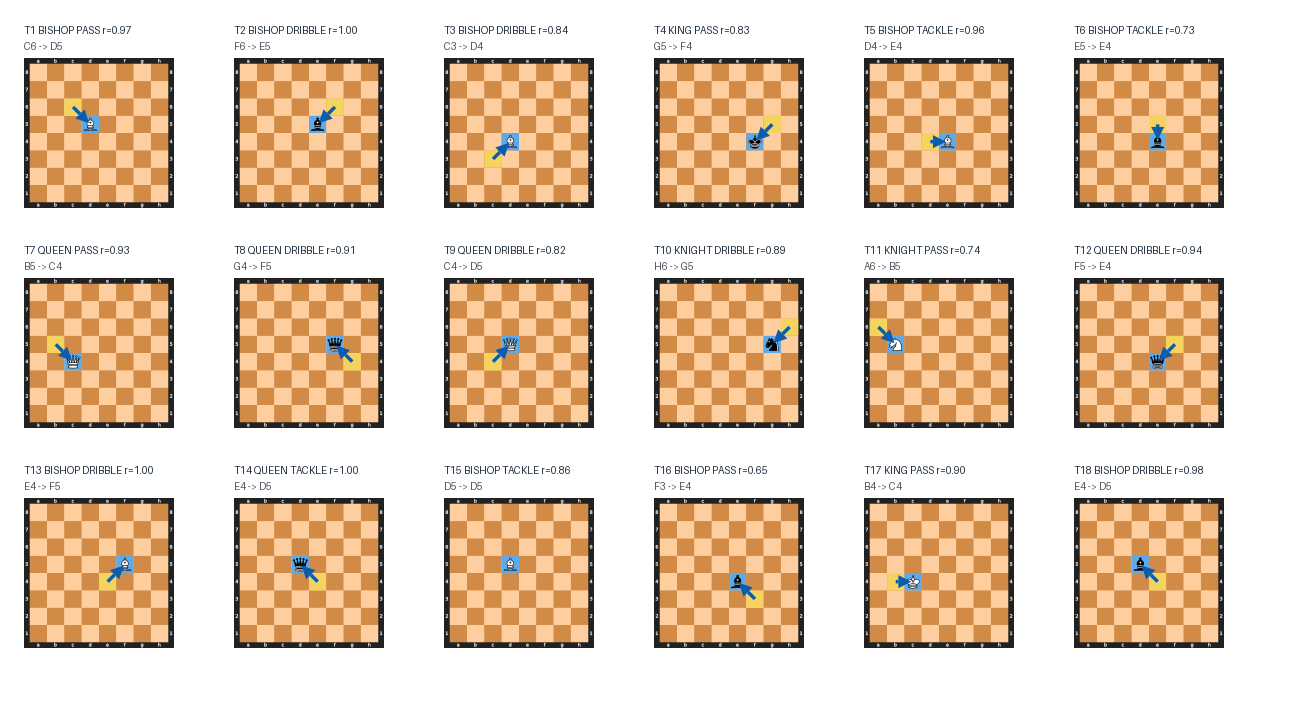
Match Shape
Discourse B (0.858); aesthetic B (0.899); repetition 0.188. Move mix: 9 pass, 22 advance, 13 challenge, 2 claim, 2 save.
- Turn 5
Checked Bishop Euclid tests the opposing line. - Turn 40
Checked Bishop Stafford Beer is denied closure. - Turn 46
Stafford Beer releases to Knight Norbert Wiener, who presses a claim. - Turn 47
Claude Shannon releases to Bishop Euclid, who presses a claim.
Full Call Sheet
| Turn | Score | Action | Call | Relevance |
|---|---|---|---|---|
| 1 | 0-0 | Pass | Bishop Gottfried Wilhelm Leibniz re-centers the question. | 0.974 |
| 2 | 0-0 | Advance | Bishop Charles Babbage develops the line. | 1.000 |
| 3 | 0-0 | Advance | Gottfried Wilhelm Leibniz releases to Bishop Euclid, who develops the line. | 0.836 |
| 4 | 0-0 | Pass | Charles Babbage releases to King Leonardo da Vinci, who re-centers the question. | 0.831 |
| 5 | 0-0 | Challenge | Checked Bishop Euclid tests the opposing line. | 0.957 |
| 6 | 0-0 | Challenge | Bishop Charles Babbage tests the opposing line. | 0.726 |
| 7 | 0-0 | Pass | Euclid releases to Queen René Descartes, who re-centers the question. | 0.933 |
| 8 | 0-0 | Advance | Charles Babbage releases to Queen Marie Curie, who develops the line. | 0.913 |
| 9 | 0-0 | Advance | Queen René Descartes develops the line. | 0.817 |
| 10 | 0-0 | Advance | Marie Curie releases to Knight Nikola Tesla, who develops the line. | 0.889 |
| 11 | 0-0 | Pass | René Descartes releases to Knight Claude Shannon, who re-centers the question. | 0.736 |
| 12 | 0-0 | Advance | Queen Marie Curie develops the line. | 0.940 |
| 13 | 0-0 | Advance | Bishop Euclid develops the line. | 1.000 |
| 14 | 0-0 | Challenge | Checked Queen Marie Curie tests the opposing line. | 0.999 |
| 15 | 0-0 | Challenge | Euclid releases to Bishop Gottfried Wilhelm Leibniz, who tests the opposing line. | 0.862 |
| 16 | 0-0 | Pass | Bishop Stafford Beer re-centers the question. | 0.654 |
| 17 | 0-0 | Pass | Gottfried Wilhelm Leibniz releases to King Lewis Carroll, who re-centers the question. | 0.903 |
| 18 | 0-0 | Advance | Stafford Beer releases to Bishop Charles Babbage, who develops the line. | 0.978 |
| 19 | 0-0 | Advance | Lewis Carroll releases to Queen René Descartes, who develops the line. | 1.000 |
| 20 | 0-0 | Pass | Charles Babbage releases to King Leonardo da Vinci, who re-centers the question. | 1.000 |
| 21 | 0-0 | Advance | René Descartes releases to King Lewis Carroll, who develops the line. | 0.857 |
| 22 | 0-0 | Advance | Leonardo da Vinci releases to Queen Marie Curie, who develops the line. | 1.000 |
| 23 | 0-0 | Challenge | Checked King Lewis Carroll tests the opposing line. | 0.982 |
| 24 | 0-0 | Advance | Marie Curie releases to Bishop Charles Babbage, who develops the line. | 1.000 |
| 25 | 0-0 | Pass | Lewis Carroll releases to Knight Blaise Pascal, who re-centers the question. | 0.960 |
| 26 | 0-0 | Challenge | Checked Bishop Charles Babbage tests the opposing line. | 1.000 |
| 27 | 0-0 | Advance | Blaise Pascal releases to Bishop Euclid, who develops the line. | 0.892 |
| 28 | 0-0 | Pass | King Leonardo da Vinci re-centers the question. | 0.936 |
| 29 | 0-0 | Advance | Queen René Descartes develops the line. | 1.000 |
| 30 | 0-0 | Advance | Leonardo da Vinci releases to Bishop Stafford Beer, who develops the line. | 1.000 |
| 31 | 0-0 | Challenge | René Descartes releases to Bishop Gottfried Wilhelm Leibniz, who tests the opposing line. | 0.908 |
| 32 | 0-0 | Challenge | Stafford Beer releases to Knight Norbert Wiener, who tests the opposing line. | 0.777 |
| 33 | 0-0 | Advance | Gottfried Wilhelm Leibniz releases to Queen René Descartes, who develops the line. | 0.953 |
| 34 | 0-0 | Advance | Checked Knight Norbert Wiener develops the line. | 0.960 |
| 35 | 0-0 | Advance | René Descartes releases to Bishop Euclid, who develops the line. | 1.000 |
| 36 | 0-0 | Challenge | Checked Knight Norbert Wiener tests the opposing line. | 0.740 |
| 37 | 0-0 | Advance | Knight Claude Shannon develops the line. | 0.949 |
| 38 | 0-0 | Challenge | Norbert Wiener releases to Bishop Stafford Beer, who tests the opposing line. | 0.832 |
| 39 | 0-0 | Challenge | Claude Shannon releases to Bishop Gottfried Wilhelm Leibniz, who tests the opposing line. | 1.000 |
| 40 | 0-0 | Save | Checked Bishop Stafford Beer is denied closure. | 0.777 |
| 41 | 0-0 | Save | Checked Bishop Gottfried Wilhelm Leibniz is denied closure. | 1.000 |
| 42 | 0-0 | Advance | Checked Bishop Stafford Beer develops the line. | 1.000 |
| 43 | 0-0 | Advance | Gottfried Wilhelm Leibniz releases to Knight Claude Shannon, who develops the line. | 0.985 |
| 44 | 0-0 | Challenge | Checked Bishop Stafford Beer tests the opposing line. | 0.792 |
| 45 | 0-0 | Challenge | Checked Knight Claude Shannon tests the opposing line. | 0.802 |
| 46 | 0-1 | Claim | Stafford Beer releases to Knight Norbert Wiener, who presses a claim. | 0.895 |
| 47 | 1-1 | Claim | Claude Shannon releases to Bishop Euclid, who presses a claim. | 0.912 |
| 48 | 1-1 | Advance | Queen Marie Curie develops the line. | 1.000 |