Group B · Match 13
MATH (Lewis Carroll) vs SOC (Jane Addams)
Result 2-2. Outcome: Draw.
Realtime Call
-
Turn 1. Bishop answers: "Et quand on envisage la question de ce biais, les difficultés disparaissent du même coup."
\nThe inquiry keeps moving.
-
Turn 2. Pass. "For surely, sir, you will not assert, that a duty can be binding which is not founded on reason".
\nThe inquiry keeps moving.
-
Turn 3. Bishop answers: "La multiplicité sans borne, c'est aussi ce que suppose la nature même de la monade."
\nThe challenge gives the next answer real work to do.
-
Turn 4. Pass. "We have come to have an enormous interest in human life as such, accompanied by confidence in its essential soundness."
\nThe inquiry keeps moving.
-
Turn 5. Bishop answers: "En les introduisant à la place du continu, l'on ne change rien qu'aux yeux de l'imagination."
\nThe move answers pressure.
-
Turn 6. Bishop answers: "I can defend it on this basis, and that is why this answer matters."
\nThe inquiry keeps moving.
-
Turn 7. Bishop answers: "Et l'on n'observe pas que c'est «une fiction, que la nature ne souffre point»."
\nThe challenge gives the next answer real work to do.
-
Turn 8. Challenge. "Who made man the exclusive judge, if woman partake with him the gift of reason".
\nThe challenge gives the next answer real work to do.
-
Turn 9. Bishop answers: "Et quand on envisage la question de ce biais, les difficultés disparaissent du même coup."
\nClosure is delayed at 0-0.
-
Turn 10. Advance. "It was shortly after this, that she commenced the work to which these remarks are prefixed."
\nThe move answers pressure.
-
Turn 11. Bishop answers: "La multiplicité sans borne, c'est aussi ce que suppose la nature même de la monade."
\nThe challenge gives the next answer real work to do.
-
Turn 12. Advance. "They may be convenient slaves, but slavery will have its constant effect, degrading the master and the abject dependent."
\nThe move answers pressure.
-
Turn 13. Pass. "And, in the present work, the difficulties of the "5 Liars" Problem, at p."
\nThe move answers pressure.
-
Turn 14. Advance. "For surely, sir, you will not assert, that a duty can be binding which is not founded on reason".
\nThe move answers pressure.
-
Turn 15. Advance. "For to be possessed of a vigorous mind is not enough; the prime requisite is rightly to apply it."
\nThe move answers pressure.
-
Turn 16. Bishop answers: "That means the stronger reading is likely in this direction under pressure."
\nThe move answers pressure.
-
Turn 17. Advance. "I esteemed eloquence highly, and was in raptures with poesy; but I thought that both were gifts of nature rather than fruits of study."
\nThe inquiry keeps moving.
-
Turn 18. Challenge. "BULLOCK, Ph.D., Assistant Professor of Economics, Williams College. *Social Control: A Survey of the Foundations of Order*."
\nThe challenge gives the next answer real work to do.
-
Turn 19. Challenge. "For to hold converse with those of other ages and to travel, are almost the same thing."
\nThe challenge gives the next answer real work to do.
-
Turn 20. Advance. "Literature, too, portrays an equally absorbing though better adjusted desire to know all kinds of life."
\nThe move answers pressure.
-
Turn 21. Claim. "I was thus led to infer that the ground of our opinions is far more custom and example than any certain knowledge."
\nThe score moves to 1-0.
-
Turn 22. Bishop answers: "But the nature of this work is such, that it receives addition as often as it is revised."
\nThe move answers pressure.
-
Turn 23. Pass. "Soriteses", will, I fear, be condemned as "bad English", unless I say a word in its defence."
\nThe inquiry keeps moving.
-
Turn 24. Bishop answers: "Nor in truth can it be rightly inferred, _This Confession is of human ordinance, therefore Christ is not its Author_."
\nThe move answers pressure.
-
Turn 25. Advance. "And then, you know, one is so _patient_ with one's self: one _never_ gets irritated at one's own stupidity!"
\nThe move answers pressure.
-
Turn 26. Bishop answers: "That means the stronger reading is likely in this direction under pressure."
\nThe move answers pressure.
-
Turn 27. Bishop answers: "The Solution of a problem is the method of construction which accomplishes the required end."
\nThe inquiry keeps moving.
-
Turn 28. Claim. "Who made man the exclusive judge, if woman partake with him the gift of reason".
\nThe score moves to 1-1.
-
Turn 29. Bishop answers: "In compiling his work the Editor has received invaluable assistance from the late Rev."
\nThe move answers pressure.
-
Turn 30. Pass. "The neighborhood mind is at once confronted not only by the difference of method, but by an absolute clashing of two ethical standards."
\nThe inquiry keeps moving.
-
Turn 31. Knight asks: "If this line is valid, what would it imply for the other side to justify now?"
\nThe move answers pressure.
-
Turn 32. Bishop answers: "I can defend it on this basis, and that is why this answer matters."
\nThe challenge gives the next answer real work to do.
-
Turn 33. Claim. "For to be possessed of a vigorous mind is not enough; the prime requisite is rightly to apply it."
\nThe score moves to 2-1.
-
Turn 34. Bishop answers: "I can defend it on this basis, and that is why this answer matters."
\nClosure is delayed at 2-1.
-
Turn 35. Knight asks: "If this line is valid, what would it imply for the other side to justify now?"
\nThe inquiry keeps moving.
-
Turn 36. Bishop answers: "I can defend it on this basis, and that is why this answer matters."
\nThe challenge gives the next answer real work to do.
-
Turn 37. Knight asks: "If this line is valid, what would it imply for the other side to justify now?"
\nThe challenge gives the next answer real work to do.
-
Turn 38. Bishop answers: "And not without cause, for when were the Grecian Demosthenes or Roman Cicero ever guilty of the like."
\nThe move answers pressure.
-
Turn 39. Knight asks: "If this line is valid, what would it imply for the other side to justify now?"
\nThe move answers pressure.
-
Turn 40. Pass. "We have come to have an enormous interest in human life as such, accompanied by confidence in its essential soundness."
\nThe move answers pressure.
-
Turn 41. Knight asks: "If this line is valid, what would it imply for the other side to justify now?"
\nThe challenge gives the next answer real work to do.
-
Turn 42. Claim. "BULLOCK, Ph.D., Assistant Professor of Economics, Williams College. *Social Control: A Survey of the Foundations of Order*."
\nThe score moves to 2-2.
-
Turn 43. Bishop answers: "An acute angle is one which is less than a right angle, as A . x v i ."
\nClosure is delayed at 2-2.
-
Turn 44. Advance. "It was shortly after this, that she commenced the work to which these remarks are prefixed."
\nThe inquiry keeps moving.
-
Turn 45. Advance. "And, all the while, you have been leaving unexplored a perfect _mine_ of wealth."
\nThe inquiry keeps moving.
-
Turn 46. Challenge. "They may be convenient slaves, but slavery will have its constant effect, degrading the master and the abject dependent."
\nThe challenge gives the next answer real work to do.
-
Turn 47. Advance. "I esteemed eloquence highly, and was in raptures with poesy; but I thought that both were gifts of nature rather than fruits of study."
\nThe move answers pressure.
-
Turn 48. Bishop answers: "But who are they that for no other reason but that they were weary of life have hastened their own fate."
\nClosure is delayed at 2-2.
Board Record
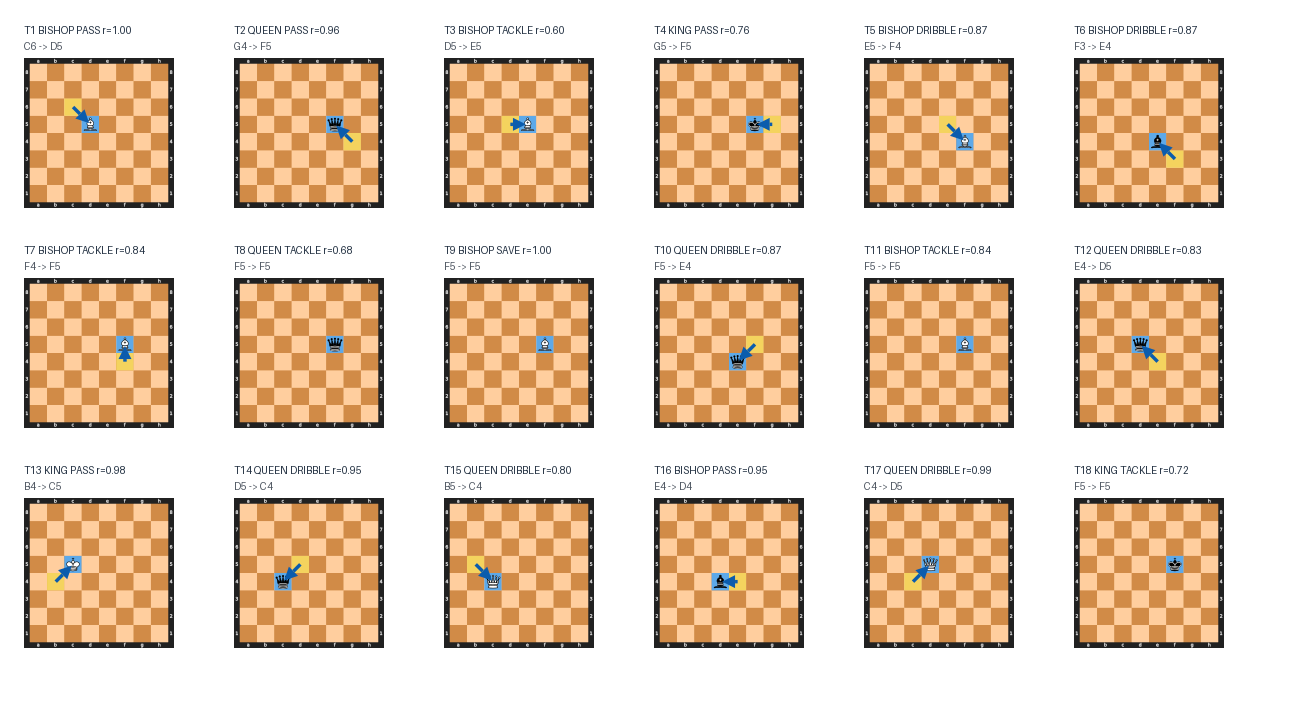
Match Shape
Discourse B (0.879); aesthetic B (0.873); repetition 0.256. Move mix: 12 pass, 17 advance, 11 challenge, 4 claim, 4 save.
- Turn 3
Checked Bishop Gottfried Wilhelm Leibniz tests the opposing line. - Turn 9
Checked Bishop Gottfried Wilhelm Leibniz is denied closure. - Turn 21
Checked Queen René Descartes presses a claim. - Turn 33
Queen René Descartes presses a claim.
Full Call Sheet
| Turn | Score | Action | Call | Relevance |
|---|---|---|---|---|
| 1 | 0-0 | Pass | Bishop Gottfried Wilhelm Leibniz re-centers the question. | 1.000 |
| 2 | 0-0 | Pass | Queen Mary Wollstonecraft re-centers the question. | 0.957 |
| 3 | 0-0 | Challenge | Checked Bishop Gottfried Wilhelm Leibniz tests the opposing line. | 0.601 |
| 4 | 0-0 | Pass | King Jane Addams re-centers the question. | 0.764 |
| 5 | 0-0 | Advance | Checked Bishop Gottfried Wilhelm Leibniz develops the line. | 0.873 |
| 6 | 0-0 | Advance | Bishop Paulo Freire develops the line. | 0.870 |
| 7 | 0-0 | Challenge | Checked Bishop Gottfried Wilhelm Leibniz tests the opposing line. | 0.842 |
| 8 | 0-0 | Challenge | Queen Mary Wollstonecraft tests the opposing line. | 0.679 |
| 9 | 0-0 | Save | Checked Bishop Gottfried Wilhelm Leibniz is denied closure. | 1.000 |
| 10 | 0-0 | Advance | Checked Queen Mary Wollstonecraft develops the line. | 0.869 |
| 11 | 0-0 | Challenge | Checked Bishop Gottfried Wilhelm Leibniz tests the opposing line. | 0.838 |
| 12 | 0-0 | Advance | Checked Queen Mary Wollstonecraft develops the line. | 0.834 |
| 13 | 0-0 | Pass | Gottfried Wilhelm Leibniz releases to King Lewis Carroll, who re-centers the question. | 0.983 |
| 14 | 0-0 | Advance | Checked Queen Mary Wollstonecraft develops the line. | 0.952 |
| 15 | 0-0 | Advance | Lewis Carroll releases to Queen René Descartes, who develops the line. | 0.796 |
| 16 | 0-0 | Pass | Mary Wollstonecraft releases to Bishop Paulo Freire, who re-centers the question. | 0.955 |
| 17 | 0-0 | Advance | Queen René Descartes develops the line. | 0.993 |
| 18 | 0-0 | Challenge | Paulo Freire releases to King Jane Addams, who tests the opposing line. | 0.722 |
| 19 | 0-0 | Challenge | Checked Queen René Descartes tests the opposing line. | 1.000 |
| 20 | 0-0 | Advance | Checked King Jane Addams develops the line. | 0.858 |
| 21 | 1-0 | Claim | Checked Queen René Descartes presses a claim. | 1.000 |
| 22 | 1-0 | Pass | Jane Addams releases to Bishop Desiderius Erasmus, who re-centers the question. | 0.954 |
| 23 | 1-0 | Pass | King Lewis Carroll re-centers the question. | 0.697 |
| 24 | 1-0 | Advance | Checked Bishop Desiderius Erasmus develops the line. | 0.975 |
| 25 | 1-0 | Advance | Checked King Lewis Carroll develops the line. | 1.000 |
| 26 | 1-0 | Pass | Desiderius Erasmus releases to Bishop Paulo Freire, who re-centers the question. | 0.913 |
| 27 | 1-0 | Pass | Bishop Euclid re-centers the question. | 0.814 |
| 28 | 1-1 | Claim | Paulo Freire releases to Queen Mary Wollstonecraft, who presses a claim. | 1.000 |
| 29 | 1-1 | Advance | Checked Bishop Euclid develops the line. | 0.965 |
| 30 | 1-1 | Pass | King Jane Addams re-centers the question. | 0.960 |
| 31 | 1-1 | Pass | Euclid releases to Knight Blaise Pascal, who re-centers the question. | 0.820 |
| 32 | 1-1 | Challenge | Jane Addams releases to Bishop Paulo Freire, who tests the opposing line. | 0.920 |
| 33 | 2-1 | Claim | Queen René Descartes presses a claim. | 1.000 |
| 34 | 2-1 | Save | Checked Bishop Paulo Freire is denied closure. | 0.944 |
| 35 | 2-1 | Advance | Knight Blaise Pascal develops the line. | 0.869 |
| 36 | 2-1 | Challenge | Checked Bishop Paulo Freire tests the opposing line. | 0.924 |
| 37 | 2-1 | Challenge | Checked Knight Blaise Pascal tests the opposing line. | 0.901 |
| 38 | 2-1 | Advance | Paulo Freire releases to Bishop Desiderius Erasmus, who develops the line. | 1.000 |
| 39 | 2-1 | Advance | Checked Knight Blaise Pascal develops the line. | 0.760 |
| 40 | 2-1 | Pass | Desiderius Erasmus releases to King Jane Addams, who re-centers the question. | 0.973 |
| 41 | 2-1 | Challenge | Checked Knight Blaise Pascal tests the opposing line. | 1.000 |
| 42 | 2-2 | Claim | Checked King Jane Addams presses a claim. | 0.940 |
| 43 | 2-2 | Save | Blaise Pascal releases to Bishop Euclid, who is denied closure. | 0.892 |
| 44 | 2-2 | Advance | Queen Mary Wollstonecraft develops the line. | 1.000 |
| 45 | 2-2 | Advance | King Lewis Carroll develops the line. | 1.000 |
| 46 | 2-2 | Challenge | Checked Queen Mary Wollstonecraft tests the opposing line. | 0.985 |
| 47 | 2-2 | Advance | Lewis Carroll releases to Queen René Descartes, who develops the line. | 1.000 |
| 48 | 2-2 | Save | Mary Wollstonecraft releases to Bishop Desiderius Erasmus, who is denied closure. | 1.000 |