Group B · Match 14
MATH (Lewis Carroll) vs AINS (George Kelly)
Result 1-0. Outcome: MATH (Lewis Carroll).
Realtime Call
-
Turn 1. Pass. "And, in the present work, the difficulties of the "5 Liars" Problem, at p."
\nThe inquiry keeps moving.
-
Turn 2. Knight asks: "Buildings and ramps and open-air machinery; the city was sealed in a protective dust-proof envelope?"
\nThe inquiry keeps moving.
-
Turn 3. Advance. "Soriteses", will, I fear, be condemned as "bad English", unless I say a word in its defence."
\nThe move answers pressure.
-
Turn 4. Bishop answers: "Let’s take that test seriously; here is how it holds together."
\nThe move answers pressure.
-
Turn 5. Bishop answers: "The Solution of a problem is the method of construction which accomplishes the required end."
\nThe move answers pressure.
-
Turn 6. Bishop answers: "I can defend it on this basis, and that is why this answer matters."
\nThe challenge gives the next answer real work to do.
-
Turn 7. Bishop answers: "In compiling his work the Editor has received invaluable assistance from the late Rev."
\nThe move answers pressure.
-
Turn 8. Knight asks: "We have all their planets except the inner Orion string--not that they're worth much, but it's the principle of the thing?"
\nThe move answers pressure.
-
Turn 9. Bishop answers: "An acute angle is one which is less than a right angle, as A . x v i ."
\nThe challenge gives the next answer real work to do.
-
Turn 10. Knight asks: "What assumption are we testing if knight keeps the focus here?"
\nThe inquiry keeps moving.
-
Turn 11. Bishop answers: "A circle may be described from any centre, and with any distance from that centre as radius."
\nThe move answers pressure.
-
Turn 12. Pass. "Instead, we must proceed by a method which shall tend to make possible to the child complete liberty."
\nThe move answers pressure.
-
Turn 13. Pass. "For to be possessed of a vigorous mind is not enough; the prime requisite is rightly to apply it."
\nThe move answers pressure.
-
Turn 14. Bishop answers: "I can defend it on this basis, and that is why this answer matters."
\nThe challenge gives the next answer real work to do.
-
Turn 15. Advance. "I esteemed eloquence highly, and was in raptures with poesy; but I thought that both were gifts of nature rather than fruits of study."
\nThe inquiry keeps moving.
-
Turn 16. Bishop answers: "I can defend it on this basis, and that is why this answer matters."
\nClosure is delayed at 0-0.
-
Turn 17. Bishop answers: "Et quand on envisage la question de ce biais, les difficultés disparaissent du même coup."
\nThe inquiry keeps moving.
-
Turn 18. Bishop answers: "I can defend it on this basis, and that is why this answer matters."
\nThe move answers pressure.
-
Turn 19. Bishop answers: "The Solution of a problem is the method of construction which accomplishes the required end."
\nThe inquiry keeps moving.
-
Turn 20. Bishop answers: "I can defend it on this basis, and that is why this answer matters."
\nThe challenge gives the next answer real work to do.
-
Turn 21. Challenge. "And then, you know, one is so _patient_ with one's self: one _never_ gets irritated at one's own stupidity!"
\nThe challenge gives the next answer real work to do.
-
Turn 22. Knight asks: "What assumption are we testing if knight keeps the focus here?"
\nThe inquiry keeps moving.
-
Turn 23. Advance. "For to hold converse with those of other ages and to travel, are almost the same thing."
\nThe inquiry keeps moving.
-
Turn 24. Advance. "DISCIPLINE The pedagogical method of _observation_ has for its base the _liberty_ of the child; and _liberty is activity_."
\nThe move answers pressure.
-
Turn 25. Bishop answers: "La multiplicité sans borne, c'est aussi ce que suppose la nature même de la monade."
\nThe move answers pressure.
-
Turn 26. Challenge. "The general question of individual liberty is thus reduced to a series of practical problems of adjustment."
\nThe challenge gives the next answer real work to do.
-
Turn 27. Challenge. "I was thus led to infer that the ground of our opinions is far more custom and example than any certain knowledge."
\nThe challenge gives the next answer real work to do.
-
Turn 28. Bishop answers: "There had been another change, though, that was significant enough and that was in the colors."
\nThe move answers pressure.
-
Turn 29. Advance. "For to be possessed of a vigorous mind is not enough; the prime requisite is rightly to apply it."
\nThe move answers pressure.
-
Turn 30. Bishop answers: "Good Lord, what man in Robotics has not been investigated and cleared to death by your people."
\nThe challenge gives the next answer real work to do.
-
Turn 31. Advance. "I esteemed eloquence highly, and was in raptures with poesy; but I thought that both were gifts of nature rather than fruits of study."
\nThe move answers pressure.
-
Turn 32. Pass. Isaac Asimov releases to King George Kelly, who re-centers the question.
\nThe move answers pressure.
-
Turn 33. Pass. "And, all the while, you have been leaving unexplored a perfect _mine_ of wealth."
\nThe inquiry keeps moving.
-
Turn 34. Knight asks: "Tony noticed the Pas-udeti's sudden change of expression, and he was puzzled?"
\nThe inquiry keeps moving.
-
Turn 35. Advance. "And, in the present work, the difficulties of the "5 Liars" Problem, at p."
\nThe inquiry keeps moving.
-
Turn 36. Knight asks: "The hot dust lapped at his ankles; he automatically moved his feet and slapped at his trousers?"
\nThe challenge gives the next answer real work to do.
-
Turn 37. Challenge. "Soriteses", will, I fear, be condemned as "bad English", unless I say a word in its defence."
\nThe challenge gives the next answer real work to do.
-
Turn 38. Knight asks: "Buildings and ramps and open-air machinery; the city was sealed in a protective dust-proof envelope?"
\nClosure is delayed at 0-0.
-
Turn 39. Advance. "And then, you know, one is so _patient_ with one's self: one _never_ gets irritated at one's own stupidity!"
\nThe move answers pressure.
-
Turn 40. Bishop answers: "Elias Lynn was a large man, almost charmingly homely, with pale blue eyes that bulged a bit."
\nThe inquiry keeps moving.
-
Turn 41. Pass. "And, all the while, you have been leaving unexplored a perfect _mine_ of wealth."
\nThe move answers pressure.
-
Turn 42. Bishop answers: "I can defend it on this basis, and that is why this answer matters."
\nClosure is delayed at 0-0.
-
Turn 43. Bishop answers: "En les introduisant à la place du continu, l'on ne change rien qu'aux yeux de l'imagination."
\nThe score moves to 1-0.
-
Turn 44. Bishop answers: "I can defend it on this basis, and that is why this answer matters."
\nThe challenge gives the next answer real work to do.
-
Turn 45. Bishop answers: "Et l'on n'observe pas que c'est «une fiction, que la nature ne souffre point»."
\nThe inquiry keeps moving.
-
Turn 46. Save. "The principle in this case consists of the affirmation of the child's need for social training."
\nClosure is delayed at 1-0.
-
Turn 47. Knight asks: "If this line is valid, what would it imply for the other side to justify now?"
\nThe inquiry keeps moving.
-
Turn 48. Knight asks: "We have all their planets except the inner Orion string--not that they're worth much, but it's the principle of the thing?"
\nThe challenge gives the next answer real work to do.
Board Record
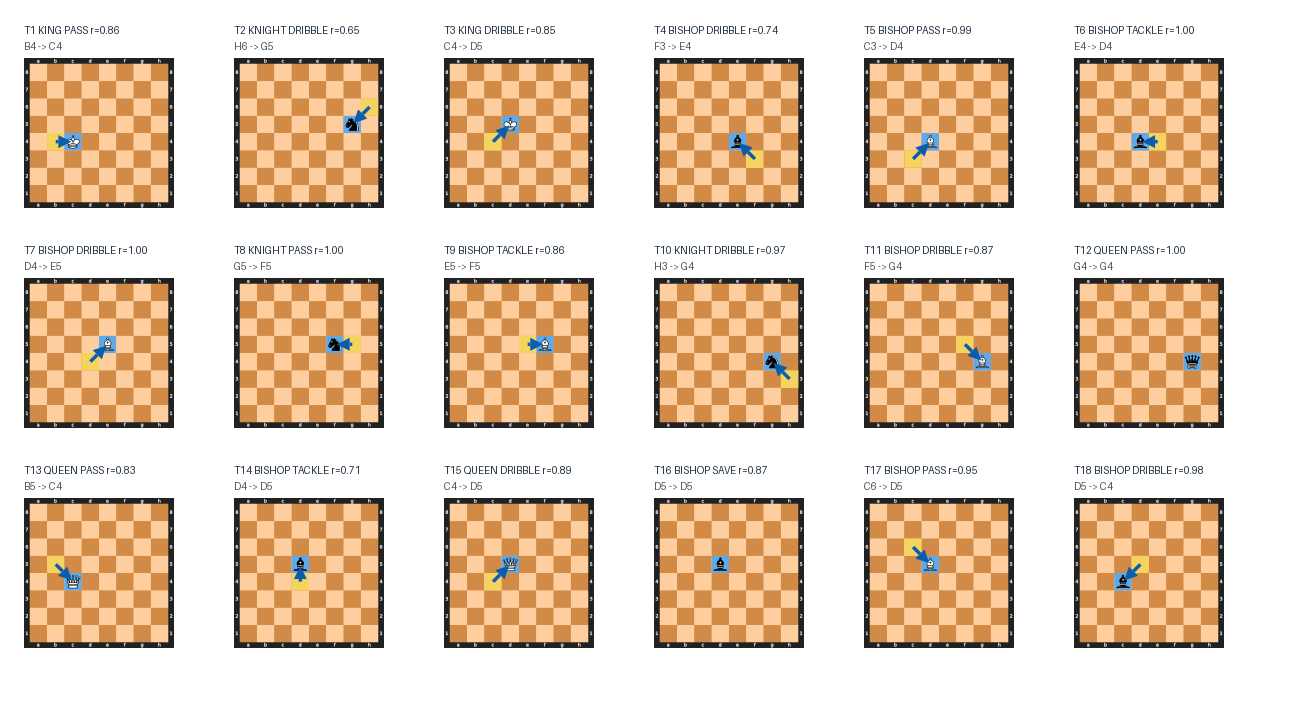
Match Shape
Discourse B (0.824); aesthetic B (0.850); repetition 0.207. Move mix: 13 pass, 18 advance, 12 challenge, 1 claim, 4 save.
- Turn 6
Checked Bishop Confucius tests the opposing line. - Turn 7
Checked Bishop Euclid develops the line. - Turn 16
Checked Bishop Confucius is denied closure. - Turn 43
Bishop Gottfried Wilhelm Leibniz presses a claim.
Full Call Sheet
| Turn | Score | Action | Call | Relevance |
|---|---|---|---|---|
| 1 | 0-0 | Pass | King Lewis Carroll re-centers the question. | 0.859 |
| 2 | 0-0 | Advance | Knight Philip K. Dick develops the line. | 0.648 |
| 3 | 0-0 | Advance | Checked King Lewis Carroll develops the line. | 0.850 |
| 4 | 0-0 | Advance | Philip K. Dick releases to Bishop Confucius, who develops the line. | 0.745 |
| 5 | 0-0 | Pass | Lewis Carroll releases to Bishop Euclid, who re-centers the question. | 0.988 |
| 6 | 0-0 | Challenge | Checked Bishop Confucius tests the opposing line. | 1.000 |
| 7 | 0-0 | Advance | Checked Bishop Euclid develops the line. | 1.000 |
| 8 | 0-0 | Pass | Confucius releases to Knight Philip K. Dick, who re-centers the question. | 1.000 |
| 9 | 0-0 | Challenge | Checked Bishop Euclid tests the opposing line. | 0.856 |
| 10 | 0-0 | Advance | Knight John McCarthy develops the line. | 0.968 |
| 11 | 0-0 | Advance | Checked Bishop Euclid develops the line. | 0.872 |
| 12 | 0-0 | Pass | John McCarthy releases to Queen Maria Montessori, who re-centers the question. | 1.000 |
| 13 | 0-0 | Pass | Euclid releases to Queen René Descartes, who re-centers the question. | 0.834 |
| 14 | 0-0 | Challenge | Bishop Confucius tests the opposing line. | 0.706 |
| 15 | 0-0 | Advance | Queen René Descartes develops the line. | 0.886 |
| 16 | 0-0 | Save | Checked Bishop Confucius is denied closure. | 0.874 |
| 17 | 0-0 | Pass | Bishop Gottfried Wilhelm Leibniz re-centers the question. | 0.946 |
| 18 | 0-0 | Advance | Checked Bishop Confucius develops the line. | 0.984 |
| 19 | 0-0 | Advance | Bishop Euclid develops the line. | 0.935 |
| 20 | 0-0 | Challenge | Checked Bishop Confucius tests the opposing line. | 0.815 |
| 21 | 0-0 | Challenge | Euclid releases to King Lewis Carroll, who tests the opposing line. | 1.000 |
| 22 | 0-0 | Pass | Knight John McCarthy re-centers the question. | 0.951 |
| 23 | 0-0 | Advance | Queen René Descartes develops the line. | 0.898 |
| 24 | 0-0 | Advance | John McCarthy releases to Queen Maria Montessori, who develops the line. | 1.000 |
| 25 | 0-0 | Advance | René Descartes releases to Bishop Gottfried Wilhelm Leibniz, who develops the line. | 0.736 |
| 26 | 0-0 | Challenge | Checked Queen Maria Montessori tests the opposing line. | 0.800 |
| 27 | 0-0 | Challenge | Gottfried Wilhelm Leibniz releases to Queen René Descartes, who tests the opposing line. | 0.799 |
| 28 | 0-0 | Pass | Maria Montessori releases to Bishop Isaac Asimov, who re-centers the question. | 0.865 |
| 29 | 0-0 | Advance | Checked Queen René Descartes develops the line. | 0.746 |
| 30 | 0-0 | Challenge | Checked Bishop Isaac Asimov tests the opposing line. | 0.886 |
| 31 | 0-0 | Advance | Checked Queen René Descartes develops the line. | 0.959 |
| 32 | 0-0 | Pass | Isaac Asimov releases to King George Kelly, who re-centers the question. | 0.877 |
| 33 | 0-0 | Pass | King Lewis Carroll re-centers the question. | 0.932 |
| 34 | 0-0 | Advance | Knight Philip K. Dick develops the line. | 1.000 |
| 35 | 0-0 | Advance | King Lewis Carroll develops the line. | 0.991 |
| 36 | 0-0 | Challenge | Checked Knight Philip K. Dick tests the opposing line. | 0.842 |
| 37 | 0-0 | Challenge | Checked King Lewis Carroll tests the opposing line. | 1.000 |
| 38 | 0-0 | Save | Checked Knight Philip K. Dick is denied closure. | 0.922 |
| 39 | 0-0 | Advance | Checked King Lewis Carroll develops the line. | 1.000 |
| 40 | 0-0 | Pass | Bishop Isaac Asimov re-centers the question. | 1.000 |
| 41 | 0-0 | Pass | Checked King Lewis Carroll re-centers the question. | 0.959 |
| 42 | 0-0 | Save | Isaac Asimov releases to Bishop Confucius, who is denied closure. | 0.982 |
| 43 | 1-0 | Claim | Bishop Gottfried Wilhelm Leibniz presses a claim. | 0.929 |
| 44 | 1-0 | Challenge | Checked Bishop Confucius tests the opposing line. | 1.000 |
| 45 | 1-0 | Advance | Bishop Gottfried Wilhelm Leibniz develops the line. | 0.966 |
| 46 | 1-0 | Save | Confucius releases to Queen Maria Montessori, who is denied closure. | 1.000 |
| 47 | 1-0 | Pass | Knight Blaise Pascal re-centers the question. | 0.800 |
| 48 | 1-0 | Challenge | Knight Philip K. Dick tests the opposing line. | 0.864 |