Group B · Match 19
CEF (Leonardo da Vinci) vs AINS (George Kelly)
Result 2-1. Outcome: CEF (Leonardo da Vinci).
Realtime Call
-
Turn 1. Pass. King Leonardo da Vinci re-centers the question.
\nThe inquiry keeps moving.
-
Turn 2. Bishop answers: "I can defend it on this basis, and that is why this answer matters."
\nThe inquiry keeps moving.
-
Turn 3. Challenge. Checked King Leonardo da Vinci tests the opposing line.
\nThe challenge gives the next answer real work to do.
-
Turn 4. Bishop answers: "I can defend it on this basis, and that is why this answer matters."
\nThe move answers pressure.
-
Turn 5. Pass. Leonardo da Vinci releases to Queen Marie Curie, who re-centers the question.
\nThe move answers pressure.
-
Turn 6. Pass. Confucius releases to King George Kelly, who re-centers the question.
\nThe move answers pressure.
-
Turn 7. Advance. Queen Marie Curie develops the line.
\nThe inquiry keeps moving.
-
Turn 8. Advance. King George Kelly develops the line.
\nThe inquiry keeps moving.
-
Turn 9. Advance. Checked Queen Marie Curie develops the line.
\nThe move answers pressure.
-
Turn 10. Pass. Checked King George Kelly re-centers the question.
\nThe move answers pressure.
-
Turn 11. Challenge. Checked Queen Marie Curie tests the opposing line.
\nThe challenge gives the next answer real work to do.
-
Turn 12. Bishop answers: "There had been another change, though, that was significant enough and that was in the colors."
\nThe move answers pressure.
-
Turn 13. Claim. Checked Queen Marie Curie presses a claim.
\nThe score moves to 1-0.
-
Turn 14. Bishop answers: "Good Lord, what man in Robotics has not been investigated and cleared to death by your people."
\nThe challenge gives the next answer real work to do.
-
Turn 15. Bishop answers: "The economy of human time is the next advantage of machinery in manufactures."
\nThe inquiry keeps moving.
-
Turn 16. Bishop answers: "Elias Lynn was a large man, almost charmingly homely, with pale blue eyes that bulged a bit."
\nThe move answers pressure.
-
Turn 17. Bishop answers: "In pointing out the advantages of tools, we shall commence with some of the simplest. 11."
\nThe challenge gives the next answer real work to do.
-
Turn 18. Bishop answers: "Over there, They were "We" (in the appropriate language) and We were "They." Scarcely anyone gave thought to such things any more."
\nThe challenge gives the next answer real work to do.
-
Turn 19. Bishop answers: "Let’s take that test seriously; here is how it holds together."
\nThe move answers pressure.
-
Turn 20. Bishop answers: "Isaac Asimov framed this well; the inference is that we should move here."
\nThe move answers pressure.
-
Turn 21. Bishop answers: "That means the stronger reading is likely in this direction under pressure."
\nThe move answers pressure.
-
Turn 22. Advance. "Instead, we must proceed by a method which shall tend to make possible to the child complete liberty."
\nThe move answers pressure.
-
Turn 23. Bishop answers: "The simpler machines are often merely one or more tools placed in a frame, and acted on by a moving power."
\nThe challenge gives the next answer real work to do.
-
Turn 24. Bishop answers: "Let’s take that test seriously; here is how it holds together."
\nThe challenge gives the next answer real work to do.
-
Turn 25. Bishop answers: "Several of the principles which I have proposed, appear to me to have been unnoticed before."
\nThe score moves to 2-0.
-
Turn 26. Bishop answers: "I can defend it on this basis, and that is why this answer matters."
\nClosure is delayed at 2-0.
-
Turn 27. Pass. Queen Marie Curie re-centers the question.
\nThe inquiry keeps moving.
-
Turn 28. Advance. "DISCIPLINE The pedagogical method of _observation_ has for its base the _liberty_ of the child; and _liberty is activity_."
\nThe move answers pressure.
-
Turn 29. Knight asks: "If this line is valid, what would it imply for the other side to justify now?"
\nThe move answers pressure.
-
Turn 30. Challenge. Maria Montessori releases to King George Kelly, who tests the opposing line.
\nThe challenge gives the next answer real work to do.
-
Turn 31. Bishop answers: "That means the stronger reading is likely in this direction."
\nThe inquiry keeps moving.
-
Turn 32. Claim. Checked King George Kelly presses a claim.
\nThe score moves to 2-1.
-
Turn 33. Bishop answers: "That means the stronger reading is likely in this direction under pressure."
\nThe move answers pressure.
-
Turn 34. Bishop answers: "There had been another change, though, that was significant enough and that was in the colors."
\nThe inquiry keeps moving.
-
Turn 35. Knight asks: "If this line is valid, what would it imply for the other side to justify now?"
\nThe move answers pressure.
-
Turn 36. Knight asks: "Buildings and ramps and open-air machinery; the city was sealed in a protective dust-proof envelope?"
\nThe move answers pressure.
-
Turn 37. Advance. King Leonardo da Vinci develops the line.
\nThe inquiry keeps moving.
-
Turn 38. Knight asks: "We have all their planets except the inner Orion string--not that they're worth much, but it's the principle of the thing?"
\nThe challenge gives the next answer real work to do.
-
Turn 39. Challenge. Checked King Leonardo da Vinci tests the opposing line.
\nThe challenge gives the next answer real work to do.
-
Turn 40. Knight asks: "Tony noticed the Pas-udeti's sudden change of expression, and he was puzzled?"
\nThe move answers pressure.
-
Turn 41. Save. Checked King Leonardo da Vinci is denied closure.
\nClosure is delayed at 2-1.
-
Turn 42. Bishop answers: "Good Lord, what man in Robotics has not been investigated and cleared to death by your people."
\nThe move answers pressure.
-
Turn 43. Knight asks: "If this line is valid, what would it imply for the other side to justify now?"
\nThe move answers pressure.
-
Turn 44. Save. "The general question of individual liberty is thus reduced to a series of practical problems of adjustment."
\nClosure is delayed at 2-1.
-
Turn 45. Knight asks: "If this line is valid, what would it imply for the other side to justify now?"
\nThe inquiry keeps moving.
-
Turn 46. Bishop answers: "Elias Lynn was a large man, almost charmingly homely, with pale blue eyes that bulged a bit."
\nThe move answers pressure.
-
Turn 47. Bishop answers: "The economy of human time is the next advantage of machinery in manufactures."
\nThe move answers pressure.
-
Turn 48. Bishop answers: "So the core point is this: the line from D5->C4 is the better constraint."
\nThe move answers pressure.
Board Record
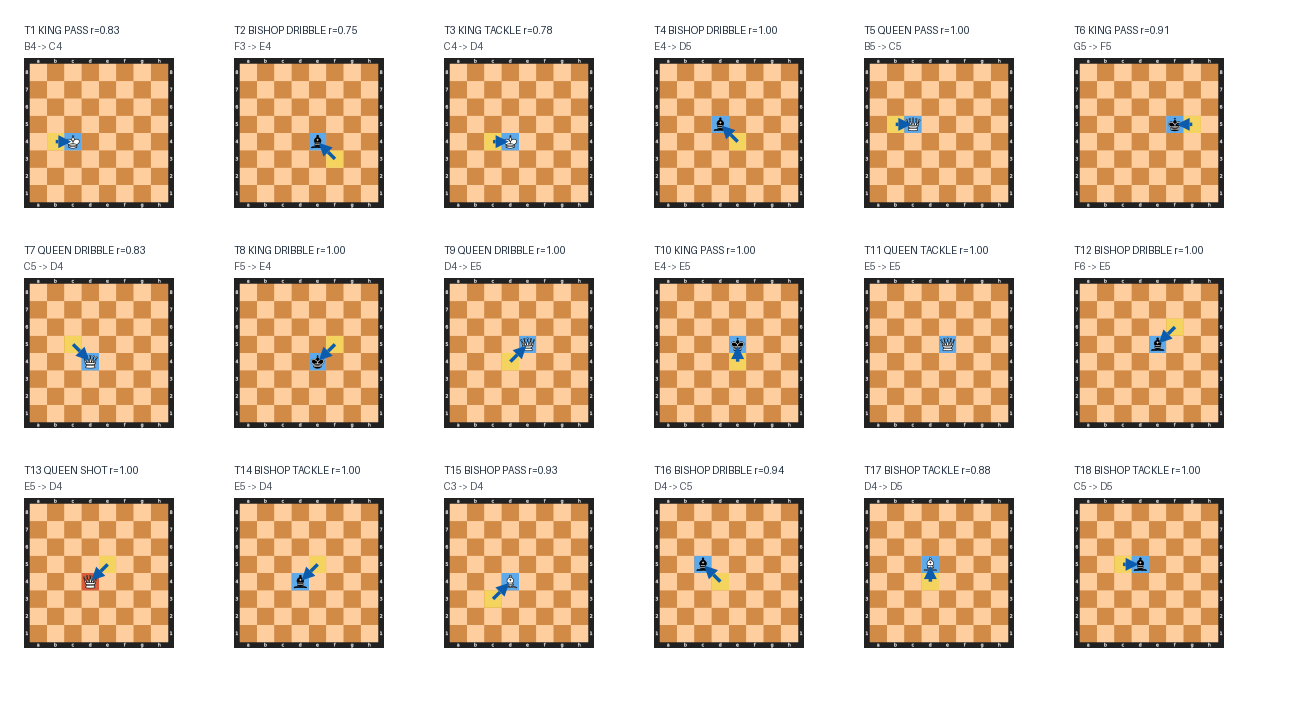
Match Shape
Discourse B (0.862); aesthetic B (0.897); repetition 0.189. Move mix: 12 pass, 20 advance, 10 challenge, 3 claim, 3 save.
- Turn 3
Checked King Leonardo da Vinci tests the opposing line. - Turn 13
Checked Queen Marie Curie presses a claim. - Turn 25
Checked Bishop Charles Babbage presses a claim. - Turn 26
Checked Bishop Confucius is denied closure.
Full Call Sheet
| Turn | Score | Action | Call | Relevance |
|---|---|---|---|---|
| 1 | 0-0 | Pass | King Leonardo da Vinci re-centers the question. | 0.829 |
| 2 | 0-0 | Advance | Bishop Confucius develops the line. | 0.754 |
| 3 | 0-0 | Challenge | Checked King Leonardo da Vinci tests the opposing line. | 0.777 |
| 4 | 0-0 | Advance | Checked Bishop Confucius develops the line. | 1.000 |
| 5 | 0-0 | Pass | Leonardo da Vinci releases to Queen Marie Curie, who re-centers the question. | 1.000 |
| 6 | 0-0 | Pass | Confucius releases to King George Kelly, who re-centers the question. | 0.907 |
| 7 | 0-0 | Advance | Queen Marie Curie develops the line. | 0.827 |
| 8 | 0-0 | Advance | King George Kelly develops the line. | 0.996 |
| 9 | 0-0 | Advance | Checked Queen Marie Curie develops the line. | 1.000 |
| 10 | 0-0 | Pass | Checked King George Kelly re-centers the question. | 1.000 |
| 11 | 0-0 | Challenge | Checked Queen Marie Curie tests the opposing line. | 1.000 |
| 12 | 0-0 | Advance | George Kelly releases to Bishop Isaac Asimov, who develops the line. | 1.000 |
| 13 | 1-0 | Claim | Checked Queen Marie Curie presses a claim. | 1.000 |
| 14 | 1-0 | Challenge | Checked Bishop Isaac Asimov tests the opposing line. | 1.000 |
| 15 | 1-0 | Pass | Bishop Charles Babbage re-centers the question. | 0.925 |
| 16 | 1-0 | Advance | Checked Bishop Isaac Asimov develops the line. | 0.938 |
| 17 | 1-0 | Challenge | Checked Bishop Charles Babbage tests the opposing line. | 0.878 |
| 18 | 1-0 | Challenge | Checked Bishop Isaac Asimov tests the opposing line. | 1.000 |
| 19 | 1-0 | Pass | Charles Babbage releases to Bishop Stafford Beer, who re-centers the question. | 0.887 |
| 20 | 1-0 | Pass | Isaac Asimov releases to Bishop Confucius, who re-centers the question. | 0.840 |
| 21 | 1-0 | Advance | Checked Bishop Stafford Beer develops the line. | 0.750 |
| 22 | 1-0 | Advance | Confucius releases to Queen Maria Montessori, who develops the line. | 0.990 |
| 23 | 1-0 | Challenge | Stafford Beer releases to Bishop Charles Babbage, who tests the opposing line. | 0.707 |
| 24 | 1-0 | Challenge | Maria Montessori releases to Bishop Confucius, who tests the opposing line. | 0.928 |
| 25 | 2-0 | Claim | Checked Bishop Charles Babbage presses a claim. | 0.892 |
| 26 | 2-0 | Save | Checked Bishop Confucius is denied closure. | 1.000 |
| 27 | 2-0 | Pass | Queen Marie Curie re-centers the question. | 1.000 |
| 28 | 2-0 | Advance | Confucius releases to Queen Maria Montessori, who develops the line. | 0.861 |
| 29 | 2-0 | Advance | Marie Curie releases to Knight Nikola Tesla, who develops the line. | 0.799 |
| 30 | 2-0 | Challenge | Maria Montessori releases to King George Kelly, who tests the opposing line. | 0.732 |
| 31 | 2-0 | Pass | Bishop Stafford Beer re-centers the question. | 1.000 |
| 32 | 2-1 | Claim | Checked King George Kelly presses a claim. | 1.000 |
| 33 | 2-1 | Advance | Checked Bishop Stafford Beer develops the line. | 1.000 |
| 34 | 2-1 | Pass | Bishop Isaac Asimov re-centers the question. | 1.000 |
| 35 | 2-1 | Advance | Stafford Beer releases to Knight Nikola Tesla, who develops the line. | 0.948 |
| 36 | 2-1 | Advance | Isaac Asimov releases to Knight Philip K. Dick, who develops the line. | 0.861 |
| 37 | 2-1 | Advance | King Leonardo da Vinci develops the line. | 0.900 |
| 38 | 2-1 | Challenge | Knight Philip K. Dick tests the opposing line. | 0.968 |
| 39 | 2-1 | Challenge | Checked King Leonardo da Vinci tests the opposing line. | 0.559 |
| 40 | 2-1 | Advance | Checked Knight Philip K. Dick develops the line. | 1.000 |
| 41 | 2-1 | Save | Checked King Leonardo da Vinci is denied closure. | 1.000 |
| 42 | 2-1 | Pass | Philip K. Dick releases to Bishop Isaac Asimov, who re-centers the question. | 0.931 |
| 43 | 2-1 | Pass | Leonardo da Vinci releases to Knight Norbert Wiener, who re-centers the question. | 0.766 |
| 44 | 2-1 | Save | Isaac Asimov releases to Queen Maria Montessori, who is denied closure. | 0.935 |
| 45 | 2-1 | Advance | Knight Nikola Tesla develops the line. | 0.982 |
| 46 | 2-1 | Advance | Maria Montessori releases to Bishop Isaac Asimov, who develops the line. | 0.939 |
| 47 | 2-1 | Advance | Nikola Tesla releases to Bishop Charles Babbage, who develops the line. | 0.978 |
| 48 | 2-1 | Advance | Isaac Asimov releases to Bishop Confucius, who develops the line. | 1.000 |