Group B · Match 20
SOC (Jane Addams) vs AINS (George Kelly)
Result 0-3. Outcome: AINS (George Kelly).
Realtime Call
-
Turn 1. Bishop answers: "That means the stronger reading is likely in this direction."
\nThe inquiry keeps moving.
-
Turn 2. Bishop answers: "I can defend it on this basis, and that is why this answer matters."
\nThe inquiry keeps moving.
-
Turn 3. Advance. "For surely, sir, you will not assert, that a duty can be binding which is not founded on reason".
\nThe move answers pressure.
-
Turn 4. Advance. Confucius releases to King George Kelly, who develops the line.
\nThe move answers pressure.
-
Turn 5. Bishop answers: "But the nature of this work is such, that it receives addition as often as it is revised."
\nThe inquiry keeps moving.
-
Turn 6. Bishop answers: "I can defend it on this basis, and that is why this answer matters."
\nThe inquiry keeps moving.
-
Turn 7. Bishop answers: "Nor in truth can it be rightly inferred, _This Confession is of human ordinance, therefore Christ is not its Author_."
\nThe move answers pressure.
-
Turn 8. Knight asks: "Buildings and ramps and open-air machinery; the city was sealed in a protective dust-proof envelope?"
\nThe challenge gives the next answer real work to do.
-
Turn 9. Bishop answers: "And not without cause, for when were the Grecian Demosthenes or Roman Cicero ever guilty of the like."
\nThe challenge gives the next answer real work to do.
-
Turn 10. Knight asks: "What assumption are we testing if knight keeps the focus here?"
\nThe inquiry keeps moving.
-
Turn 11. Pass. "Who made man the exclusive judge, if woman partake with him the gift of reason".
\nThe inquiry keeps moving.
-
Turn 12. Advance. King George Kelly develops the line.
\nThe inquiry keeps moving.
-
Turn 13. Advance. "It was shortly after this, that she commenced the work to which these remarks are prefixed."
\nThe move answers pressure.
-
Turn 14. Challenge. Checked King George Kelly tests the opposing line.
\nThe challenge gives the next answer real work to do.
-
Turn 15. Bishop answers: "Mary Wollstonecraft framed this well; the inference is that we should move here."
\nThe move answers pressure.
-
Turn 16. Bishop answers: "There had been another change, though, that was significant enough and that was in the colors."
\nThe inquiry keeps moving.
-
Turn 17. Knight asks: "It was a glimpse of another atmosphere, though the studious habits of his home life were maintained?"
\nThe move answers pressure.
-
Turn 18. Bishop answers: "Good Lord, what man in Robotics has not been investigated and cleared to death by your people."
\nThe inquiry keeps moving.
-
Turn 19. Bishop answers: "That means the stronger reading is likely in this direction."
\nThe inquiry keeps moving.
-
Turn 20. Knight asks: "What assumption are we testing if Isaac Asimov keeps the focus here?"
\nThe move answers pressure.
-
Turn 21. Bishop answers: "That means the stronger reading is likely in this direction under pressure."
\nThe challenge gives the next answer real work to do.
-
Turn 22. Knight asks: "What assumption are we testing if knight keeps the focus here?"
\nThe move answers pressure.
-
Turn 23. Bishop answers: "But who are they that for no other reason but that they were weary of life have hastened their own fate."
\nThe move answers pressure.
-
Turn 24. Pass. John McCarthy releases to King George Kelly, who re-centers the question.
\nThe move answers pressure.
-
Turn 25. Advance. "We have come to have an enormous interest in human life as such, accompanied by confidence in its essential soundness."
\nThe move answers pressure.
-
Turn 26. Bishop answers: "Elias Lynn was a large man, almost charmingly homely, with pale blue eyes that bulged a bit."
\nThe move answers pressure.
-
Turn 27. Challenge. "BULLOCK, Ph.D., Assistant Professor of Economics, Williams College. *Social Control: A Survey of the Foundations of Order*."
\nThe challenge gives the next answer real work to do.
-
Turn 28. Bishop answers: "I can defend it on this basis, and that is why this answer matters."
\nThe inquiry keeps moving.
-
Turn 29. Knight asks: "Will the charm work still, when the stock of statesmen's credibility, accumulated before these times, is getting exhausted?"
\nThe inquiry keeps moving.
-
Turn 30. Bishop answers: "I can defend it on this basis, and that is why this answer matters."
\nThe challenge gives the next answer real work to do.
-
Turn 31. Knight asks: "But they cannot work properly if the money, which they assume as a stable measuring-rod, is undependable?"
\nThe move answers pressure.
-
Turn 32. Bishop answers: "I can defend it on this basis, and that is why this answer matters."
\nClosure is delayed at 0-0.
-
Turn 33. Knight asks: "But his published work on the subject owed nothing to her, he tells us, in its doctrines?"
\nThe inquiry keeps moving.
-
Turn 34. Advance. Confucius releases to King George Kelly, who develops the line.
\nThe move answers pressure.
-
Turn 35. Knight asks: "In some of the presentation copies of his work on _Political Economy_, he wrote the following dedication:--"To Mrs?"
\nThe challenge gives the next answer real work to do.
-
Turn 36. Advance. "Instead, we must proceed by a method which shall tend to make possible to the child complete liberty."
\nThe move answers pressure.
-
Turn 37. Save. "They may be convenient slaves, but slavery will have its constant effect, degrading the master and the abject dependent."
\nClosure is delayed at 0-0.
-
Turn 38. Knight asks: "What assumption are we testing if Maria Montessori keeps the focus here?"
\nThe challenge gives the next answer real work to do.
-
Turn 39. Advance. "For surely, sir, you will not assert, that a duty can be binding which is not founded on reason".
\nThe move answers pressure.
-
Turn 40. Knight asks: "What assumption are we testing if knight keeps the focus here?"
\nThe score moves to 0-1.
-
Turn 41. Bishop answers: "That means the stronger reading is likely in this direction under pressure."
\nThe move answers pressure.
-
Turn 42. Pass. King George Kelly re-centers the question.
\nThe inquiry keeps moving.
-
Turn 43. Bishop answers: "That means the stronger reading is likely in this direction under pressure."
\nClosure is delayed at 0-1.
-
Turn 44. Claim. Checked King George Kelly presses a claim.
\nThe score moves to 0-2.
-
Turn 45. Knight asks: "Taylor, both before and after her marriage with Mill, made actual contributions to his thoughts and his public work?"
\nThe move answers pressure.
-
Turn 46. Bishop answers: "Over there, They were "We" (in the appropriate language) and We were "They." Scarcely anyone gave thought to such things any more."
\nThe inquiry keeps moving.
-
Turn 47. Knight asks: "It was a glimpse of another atmosphere, though the studious habits of his home life were maintained?"
\nClosure is delayed at 0-2.
-
Turn 48. Bishop answers: "There had been another change, though, that was significant enough and that was in the colors."
\nThe score moves to 0-3.
Board Record
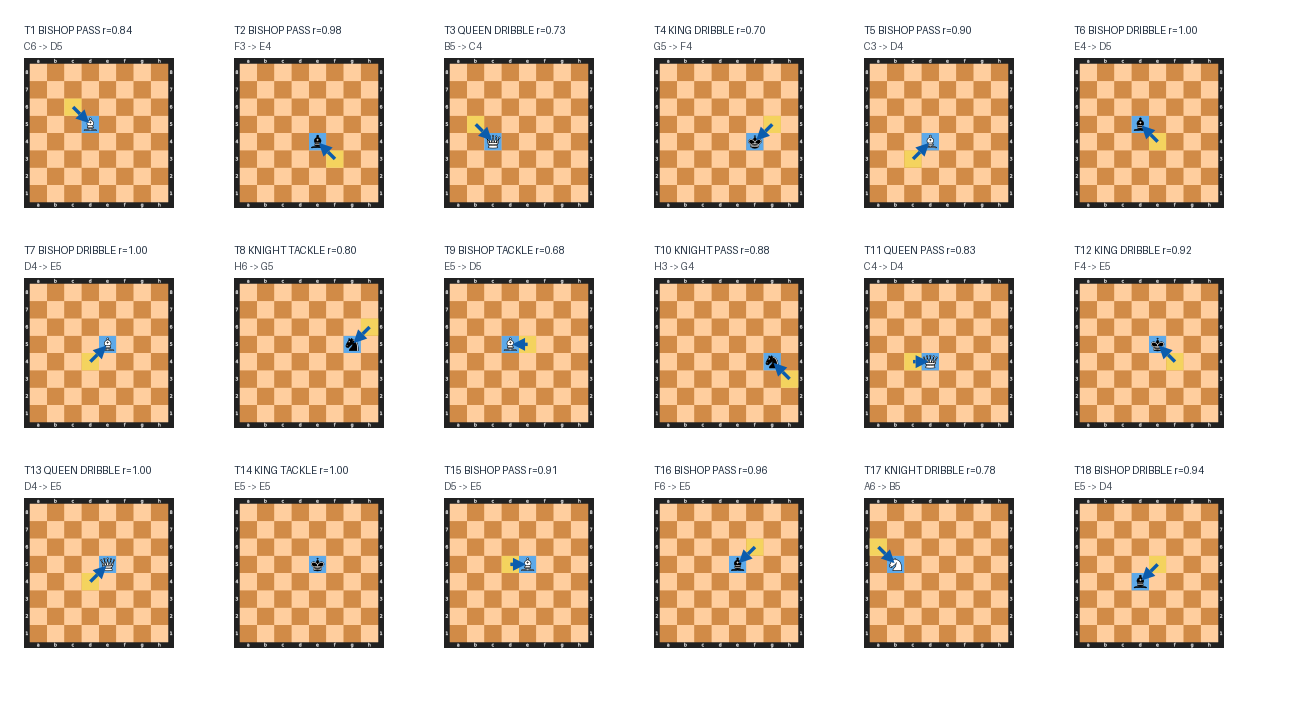
Match Shape
Discourse B (0.832); aesthetic B (0.888); repetition 0.122. Move mix: 15 pass, 18 advance, 8 challenge, 3 claim, 4 save.
- Turn 8
Confucius releases to Knight Philip K. Dick, who tests the opposing line. - Turn 32
Checked Bishop Confucius is denied closure. - Turn 40
Checked Knight John McCarthy presses a claim. - Turn 44
Checked King George Kelly presses a claim.
Full Call Sheet
| Turn | Score | Action | Call | Relevance |
|---|---|---|---|---|
| 1 | 0-0 | Pass | Bishop Paulo Freire re-centers the question. | 0.839 |
| 2 | 0-0 | Pass | Bishop Confucius re-centers the question. | 0.976 |
| 3 | 0-0 | Advance | Paulo Freire releases to Queen Mary Wollstonecraft, who develops the line. | 0.732 |
| 4 | 0-0 | Advance | Confucius releases to King George Kelly, who develops the line. | 0.702 |
| 5 | 0-0 | Pass | Bishop Desiderius Erasmus re-centers the question. | 0.901 |
| 6 | 0-0 | Advance | Bishop Confucius develops the line. | 1.000 |
| 7 | 0-0 | Advance | Checked Bishop Desiderius Erasmus develops the line. | 1.000 |
| 8 | 0-0 | Challenge | Confucius releases to Knight Philip K. Dick, who tests the opposing line. | 0.804 |
| 9 | 0-0 | Challenge | Checked Bishop Desiderius Erasmus tests the opposing line. | 0.679 |
| 10 | 0-0 | Pass | Knight John McCarthy re-centers the question. | 0.880 |
| 11 | 0-0 | Pass | Queen Mary Wollstonecraft re-centers the question. | 0.830 |
| 12 | 0-0 | Advance | King George Kelly develops the line. | 0.918 |
| 13 | 0-0 | Advance | Checked Queen Mary Wollstonecraft develops the line. | 1.000 |
| 14 | 0-0 | Challenge | Checked King George Kelly tests the opposing line. | 1.000 |
| 15 | 0-0 | Pass | Mary Wollstonecraft releases to Bishop Paulo Freire, who re-centers the question. | 0.908 |
| 16 | 0-0 | Pass | Bishop Isaac Asimov re-centers the question. | 0.957 |
| 17 | 0-0 | Advance | Paulo Freire releases to Knight John Stuart Mill, who develops the line. | 0.782 |
| 18 | 0-0 | Advance | Bishop Isaac Asimov develops the line. | 0.940 |
| 19 | 0-0 | Advance | Bishop Paulo Freire develops the line. | 1.000 |
| 20 | 0-0 | Pass | Isaac Asimov releases to Knight John McCarthy, who re-centers the question. | 1.000 |
| 21 | 0-0 | Challenge | Checked Bishop Paulo Freire tests the opposing line. | 0.803 |
| 22 | 0-0 | Advance | Checked Knight John McCarthy develops the line. | 0.895 |
| 23 | 0-0 | Pass | Paulo Freire releases to Bishop Desiderius Erasmus, who re-centers the question. | 1.000 |
| 24 | 0-0 | Pass | John McCarthy releases to King George Kelly, who re-centers the question. | 1.000 |
| 25 | 0-0 | Advance | Desiderius Erasmus releases to King Jane Addams, who develops the line. | 0.921 |
| 26 | 0-0 | Advance | George Kelly releases to Bishop Isaac Asimov, who develops the line. | 0.966 |
| 27 | 0-0 | Challenge | Checked King Jane Addams tests the opposing line. | 0.919 |
| 28 | 0-0 | Advance | Bishop Confucius develops the line. | 1.000 |
| 29 | 0-0 | Pass | Knight John Maynard Keynes re-centers the question. | 0.851 |
| 30 | 0-0 | Challenge | Checked Bishop Confucius tests the opposing line. | 1.000 |
| 31 | 0-0 | Advance | Checked Knight John Maynard Keynes develops the line. | 0.774 |
| 32 | 0-0 | Save | Checked Bishop Confucius is denied closure. | 1.000 |
| 33 | 0-0 | Advance | Knight John Stuart Mill develops the line. | 0.732 |
| 34 | 0-0 | Advance | Confucius releases to King George Kelly, who develops the line. | 0.905 |
| 35 | 0-0 | Challenge | Checked Knight John Stuart Mill tests the opposing line. | 1.000 |
| 36 | 0-0 | Advance | George Kelly releases to Queen Maria Montessori, who develops the line. | 0.890 |
| 37 | 0-0 | Save | John Stuart Mill releases to Queen Mary Wollstonecraft, who is denied closure. | 0.741 |
| 38 | 0-0 | Challenge | Maria Montessori releases to Knight John McCarthy, who tests the opposing line. | 0.908 |
| 39 | 0-0 | Advance | Checked Queen Mary Wollstonecraft develops the line. | 1.000 |
| 40 | 0-1 | Claim | Checked Knight John McCarthy presses a claim. | 0.985 |
| 41 | 0-1 | Pass | Mary Wollstonecraft releases to Bishop Paulo Freire, who re-centers the question. | 0.898 |
| 42 | 0-1 | Pass | King George Kelly re-centers the question. | 0.870 |
| 43 | 0-1 | Save | Checked Bishop Paulo Freire is denied closure. | 0.953 |
| 44 | 0-2 | Claim | Checked King George Kelly presses a claim. | 1.000 |
| 45 | 0-2 | Pass | Paulo Freire releases to Knight John Stuart Mill, who re-centers the question. | 1.000 |
| 46 | 0-2 | Pass | Bishop Isaac Asimov re-centers the question. | 0.750 |
| 47 | 0-2 | Save | Checked Knight John Stuart Mill is denied closure. | 0.863 |
| 48 | 0-3 | Claim | Checked Bishop Isaac Asimov presses a claim. | 1.000 |