Semifinal 2 · Match 24
CEF (Leonardo da Vinci) vs NAT (Albert Einstein)
Result 0-0. Outcome: NAT (Albert Einstein) by shootout (2-3).
Realtime Call
-
Turn 1. Pass. Queen Marie Curie re-centers the question.
\nThe inquiry keeps moving.
-
Turn 2. Advance. Queen David Bohm develops the line.
\nThe inquiry keeps moving.
-
Turn 3. Bishop answers: "So the core point is this: the line from C6->D5 is the better constraint."
\nThe move answers pressure.
-
Turn 4. Bishop answers: "Naturalists continually refer to external conditions, such as climate, food, etc., as the only possible cause of variation."
\nThe inquiry keeps moving.
-
Turn 5. Advance. Stafford Beer releases to Queen Marie Curie, who develops the line.
\nThe move answers pressure.
-
Turn 6. Advance. Charles Darwin releases to Queen David Bohm, who develops the line.
\nThe move answers pressure.
-
Turn 7. Bishop answers: "The economy of human time is the next advantage of machinery in manufactures."
\nThe move answers pressure.
-
Turn 8. Challenge. Checked Queen David Bohm tests the opposing line.
\nThe challenge gives the next answer real work to do.
-
Turn 9. Bishop answers: "In pointing out the advantages of tools, we shall commence with some of the simplest. 11."
\nThe move answers pressure.
-
Turn 10. Knight asks: "Natural philosophy, which preceded all exact observation in antiquity, is a natural, but not unfrequently ill-directed, effort of reason?"
\nThe move answers pressure.
-
Turn 11. Bishop answers: "The simpler machines are often merely one or more tools placed in a frame, and acted on by a moving power."
\nThe challenge gives the next answer real work to do.
-
Turn 12. Bishop answers: "I need not enumerate the actual results which the last century gained by this work."
\nThe inquiry keeps moving.
-
Turn 13. Knight asks: "If this line is valid, what would it imply for the other side to justify now?"
\nThe move answers pressure.
-
Turn 14. Bishop answers: "He had probably never dipped very deep in the latter subject, and that strengthened our doubts."
\nThe challenge gives the next answer real work to do.
-
Turn 15. Advance. Nikola Tesla releases to King Leonardo da Vinci, who develops the line.
\nThe move answers pressure.
-
Turn 16. Bishop answers: "From the strong principle of inheritance, any selected variety will tend to propagate its new and modified form."
\nThe move answers pressure.
-
Turn 17. Advance. Leonardo da Vinci releases to Queen Marie Curie, who develops the line.
\nThe move answers pressure.
-
Turn 18. Knight asks: "What assumption are we testing if Charles Darwin keeps the focus here?"
\nThe move answers pressure.
-
Turn 19. Challenge. Checked Queen Marie Curie tests the opposing line.
\nThe challenge gives the next answer real work to do.
-
Turn 20. Bishop answers: "In the last chapter I shall give a brief recapitulation of the whole work, and a few concluding remarks."
\nThe move answers pressure.
-
Turn 21. Knight asks: "If this line is valid, what would it imply for the other side to justify now?"
\nThe move answers pressure.
-
Turn 22. Bishop answers: "We now know that many of these hypotheses, which found favour in their day, far overshot the mark."
\nThe move answers pressure.
-
Turn 23. Bishop answers: "Several of the principles which I have proposed, appear to me to have been unnoticed before."
\nThe move answers pressure.
-
Turn 24. Knight asks: "That which is attained by observation and experiment (calling forth phenomena) leads, by analogy and induction, to a knowledge of 'empirical laws'; their gradual simplification and generalization?"
\nThe move answers pressure.
-
Turn 25. Bishop answers: "The economy of human time is the next advantage of machinery in manufactures."
\nThe challenge gives the next answer real work to do.
-
Turn 26. Knight asks: "The 'existing' can not be absolutely separated in our contemplation of nature from the 'future'?"
\nThe challenge gives the next answer real work to do.
-
Turn 27. Knight asks: "If this line is valid, what would it imply for the other side to justify now?"
\nThe challenge gives the next answer real work to do.
-
Turn 28. Bishop answers: "Any change in the embryo or larva will almost certainly entail changes in the mature animal."
\nThe move answers pressure.
-
Turn 29. Advance. Norbert Wiener releases to King Leonardo da Vinci, who develops the line.
\nThe move answers pressure.
-
Turn 30. Bishop answers: "Naturalists continually refer to external conditions, such as climate, food, etc., as the only possible cause of variation."
\nThe challenge gives the next answer real work to do.
-
Turn 31. Knight asks: "If this line is valid, what would it imply for the other side to justify now?"
\nThe challenge gives the next answer real work to do.
-
Turn 32. Bishop answers: "From the strong principle of inheritance, any selected variety will tend to propagate its new and modified form."
\nThe move answers pressure.
-
Turn 33. Knight asks: "If this line is valid, what would it imply for the other side to justify now?"
\nThe move answers pressure.
-
Turn 34. Pass. Queen David Bohm re-centers the question.
\nThe inquiry keeps moving.
-
Turn 35. Bishop answers: "Nikola Tesla framed this well; the inference is that we should move here."
\nThe move answers pressure.
-
Turn 36. Knight asks: "What assumption are we testing if David Bohm keeps the focus here?"
\nThe move answers pressure.
-
Turn 37. Advance. Stafford Beer releases to Queen Marie Curie, who develops the line.
\nThe move answers pressure.
-
Turn 38. Knight asks: "Misunderstood popular knowledge, confounding cosmography with a mere encyclopedic enumeration of natural sciences?"
\nThe move answers pressure.
-
Turn 39. Challenge. Checked Queen Marie Curie tests the opposing line.
\nThe challenge gives the next answer real work to do.
-
Turn 40. Knight asks: "What assumption are we testing if Alexander von Humboldt keeps the focus here?"
\nThe challenge gives the next answer real work to do.
-
Turn 41. Bishop answers: "In pointing out the advantages of tools, we shall commence with some of the simplest. 11."
\nClosure is delayed at 0-0.
-
Turn 42. Knight asks: "What assumption are we testing if knight keeps the focus here?"
\nClosure is delayed at 0-0.
-
Turn 43. Bishop answers: "So the core point is this: the line from E4->F5 is the better constraint."
\nThe move answers pressure.
-
Turn 44. Knight asks: "Natural philosophy, which preceded all exact observation in antiquity, is a natural, but not unfrequently ill-directed, effort of reason?"
\nThe move answers pressure.
-
Turn 45. Knight asks: "If this line is valid, what would it imply for the other side to justify now?"
\nThe move answers pressure.
-
Turn 46. Challenge. Alexander von Humboldt releases to Queen David Bohm, who tests the opposing line.
\nThe challenge gives the next answer real work to do.
-
Turn 47. Knight asks: "If this line is valid, what would it imply for the other side to justify now?"
\nThe challenge gives the next answer real work to do.
-
Turn 48. Save. Checked Queen David Bohm is denied closure.
\nClosure is delayed at 0-0.
-
Shootout round 1. Marie Curie for CEF (Leonardo da Vinci): goal. Shootout score 1-0.
-
Shootout round 1. David Bohm for NAT (Albert Einstein): save. Shootout score 1-0.
-
Shootout round 2. Stafford Beer for CEF (Leonardo da Vinci): save. Shootout score 1-0.
-
Shootout round 2. Charles Darwin for NAT (Albert Einstein): "In the last chapter I shall give a brief recapitulation of the whole work, and a few concluding remarks.". Shootout score 1-0.
-
Shootout round 3. Nikola Tesla for CEF (Leonardo da Vinci): save. Shootout score 1-0.
-
Shootout round 3. Alexander von Humboldt for NAT (Albert Einstein): "That which is attained by observation and experiment (calling forth phenomena) leads, by analogy and induction, to a knowledge of 'empirical laws'; their gradual simplification and generalization.". Shootout score 1-1.
-
Shootout round 4. Norbert Wiener for CEF (Leonardo da Vinci): goal. Shootout score 2-1.
-
Shootout round 4. Wolfgang Pauli for NAT (Albert Einstein): goal. Shootout score 2-2.
-
Shootout round 5. Charles Babbage for CEF (Leonardo da Vinci): "The simpler machines are often merely one or more tools placed in a frame, and acted on by a moving power.". Shootout score 2-2.
-
Shootout round 5. Hermann von Helmholtz for NAT (Albert Einstein): "Owing to the Reformation, intellectual life had lost its old stability and cohesion; everything appeared in a new light, and new questions arose.". Shootout score 2-2.
-
Shootout round 6. Leonardo da Vinci for CEF (Leonardo da Vinci): save. Shootout score 2-2.
-
Shootout round 6. Albert Einstein for NAT (Albert Einstein): "It is only with reluctance that man's desire for knowledge endures a dualism of this kind.". Shootout score 2-3.
Board Record
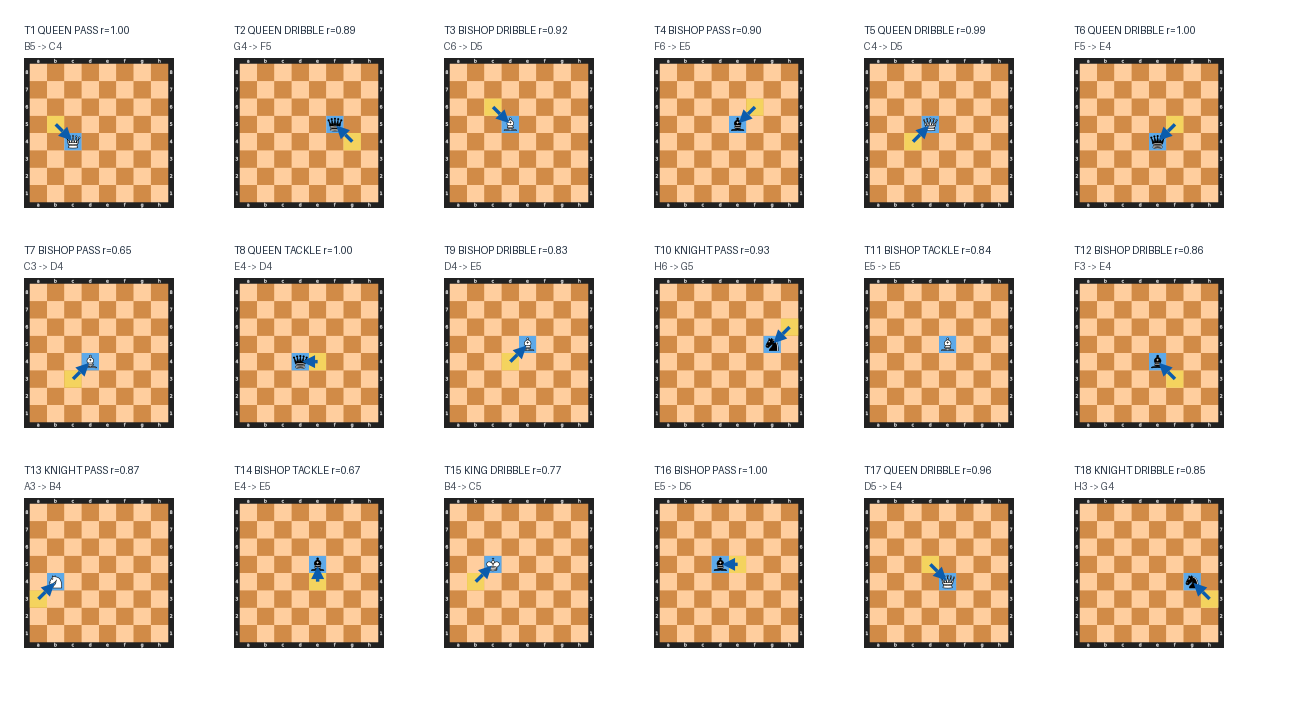
Match Shape
Discourse B (0.816); aesthetic B (0.818); repetition 0.198. Move mix: 9 pass, 23 advance, 13 challenge, 3 save.
- Turn 1
Queen Marie Curie re-centers the question. - Turn 6
Charles Darwin releases to Queen David Bohm, who develops the line. - Turn 8
Checked Queen David Bohm tests the opposing line. - Turn 41
Marie Curie releases to Bishop Charles Babbage, who is denied closure.
Shootout
| Round | Team | Faculty | Outcome | Score |
|---|---|---|---|---|
| 1 | CEF (Leonardo da Vinci) | Marie Curie | goal | 1-0 |
| 1 | NAT (Albert Einstein) | David Bohm | save | 1-0 |
| 2 | CEF (Leonardo da Vinci) | Stafford Beer | save | 1-0 |
| 2 | NAT (Albert Einstein) | Charles Darwin | save | 1-0 |
| 3 | CEF (Leonardo da Vinci) | Nikola Tesla | save | 1-0 |
| 3 | NAT (Albert Einstein) | Alexander von Humboldt | goal | 1-1 |
| 4 | CEF (Leonardo da Vinci) | Norbert Wiener | goal | 2-1 |
| 4 | NAT (Albert Einstein) | Wolfgang Pauli | goal | 2-2 |
| 5 | CEF (Leonardo da Vinci) | Charles Babbage | save | 2-2 |
| 5 | NAT (Albert Einstein) | Hermann von Helmholtz | save | 2-2 |
| 6 | CEF (Leonardo da Vinci) | Leonardo da Vinci | save | 2-2 |
| 6 | NAT (Albert Einstein) | Albert Einstein | goal | 2-3 |
Full Call Sheet
| Turn | Score | Action | Call | Relevance |
|---|---|---|---|---|
| 1 | 0-0 | Pass | Queen Marie Curie re-centers the question. | 1.000 |
| 2 | 0-0 | Advance | Queen David Bohm develops the line. | 0.894 |
| 3 | 0-0 | Advance | Marie Curie releases to Bishop Stafford Beer, who develops the line. | 0.923 |
| 4 | 0-0 | Pass | Bishop Charles Darwin re-centers the question. | 0.898 |
| 5 | 0-0 | Advance | Stafford Beer releases to Queen Marie Curie, who develops the line. | 0.990 |
| 6 | 0-0 | Advance | Charles Darwin releases to Queen David Bohm, who develops the line. | 1.000 |
| 7 | 0-0 | Pass | Marie Curie releases to Bishop Charles Babbage, who re-centers the question. | 0.649 |
| 8 | 0-0 | Challenge | Checked Queen David Bohm tests the opposing line. | 1.000 |
| 9 | 0-0 | Advance | Checked Bishop Charles Babbage develops the line. | 0.831 |
| 10 | 0-0 | Pass | David Bohm releases to Knight Alexander von Humboldt, who re-centers the question. | 0.928 |
| 11 | 0-0 | Challenge | Checked Bishop Charles Babbage tests the opposing line. | 0.836 |
| 12 | 0-0 | Advance | Bishop Hermann von Helmholtz develops the line. | 0.860 |
| 13 | 0-0 | Pass | Charles Babbage releases to Knight Nikola Tesla, who re-centers the question. | 0.871 |
| 14 | 0-0 | Challenge | Checked Bishop Hermann von Helmholtz tests the opposing line. | 0.671 |
| 15 | 0-0 | Advance | Nikola Tesla releases to King Leonardo da Vinci, who develops the line. | 0.767 |
| 16 | 0-0 | Pass | Hermann von Helmholtz releases to Bishop Charles Darwin, who re-centers the question. | 1.000 |
| 17 | 0-0 | Advance | Leonardo da Vinci releases to Queen Marie Curie, who develops the line. | 0.958 |
| 18 | 0-0 | Advance | Charles Darwin releases to Knight Wolfgang Pauli, who develops the line. | 0.847 |
| 19 | 0-0 | Challenge | Checked Queen Marie Curie tests the opposing line. | 0.910 |
| 20 | 0-0 | Advance | Wolfgang Pauli releases to Bishop Charles Darwin, who develops the line. | 0.869 |
| 21 | 0-0 | Pass | Marie Curie releases to Knight Norbert Wiener, who re-centers the question. | 0.948 |
| 22 | 0-0 | Advance | Charles Darwin releases to Bishop Hermann von Helmholtz, who develops the line. | 0.996 |
| 23 | 0-0 | Advance | Norbert Wiener releases to Bishop Charles Babbage, who develops the line. | 0.973 |
| 24 | 0-0 | Advance | Hermann von Helmholtz releases to Knight Alexander von Humboldt, who develops the line. | 1.000 |
| 25 | 0-0 | Challenge | Checked Bishop Charles Babbage tests the opposing line. | 1.000 |
| 26 | 0-0 | Challenge | Checked Knight Alexander von Humboldt tests the opposing line. | 0.914 |
| 27 | 0-0 | Challenge | Charles Babbage releases to Knight Norbert Wiener, who tests the opposing line. | 0.835 |
| 28 | 0-0 | Pass | Alexander von Humboldt releases to Bishop Charles Darwin, who re-centers the question. | 1.000 |
| 29 | 0-0 | Advance | Norbert Wiener releases to King Leonardo da Vinci, who develops the line. | 0.941 |
| 30 | 0-0 | Challenge | Checked Bishop Charles Darwin tests the opposing line. | 0.985 |
| 31 | 0-0 | Challenge | Knight Nikola Tesla tests the opposing line. | 0.991 |
| 32 | 0-0 | Advance | Checked Bishop Charles Darwin develops the line. | 0.908 |
| 33 | 0-0 | Advance | Checked Knight Nikola Tesla develops the line. | 0.890 |
| 34 | 0-0 | Pass | Queen David Bohm re-centers the question. | 0.878 |
| 35 | 0-0 | Advance | Nikola Tesla releases to Bishop Stafford Beer, who develops the line. | 0.993 |
| 36 | 0-0 | Advance | David Bohm releases to Knight Wolfgang Pauli, who develops the line. | 0.757 |
| 37 | 0-0 | Advance | Stafford Beer releases to Queen Marie Curie, who develops the line. | 1.000 |
| 38 | 0-0 | Advance | Wolfgang Pauli releases to Knight Alexander von Humboldt, who develops the line. | 0.836 |
| 39 | 0-0 | Challenge | Checked Queen Marie Curie tests the opposing line. | 0.986 |
| 40 | 0-0 | Challenge | Alexander von Humboldt releases to Knight Wolfgang Pauli, who tests the opposing line. | 1.000 |
| 41 | 0-0 | Save | Marie Curie releases to Bishop Charles Babbage, who is denied closure. | 0.975 |
| 42 | 0-0 | Save | Checked Knight Wolfgang Pauli is denied closure. | 0.860 |
| 43 | 0-0 | Advance | Charles Babbage releases to Bishop Stafford Beer, who develops the line. | 0.970 |
| 44 | 0-0 | Advance | Wolfgang Pauli releases to Knight Alexander von Humboldt, who develops the line. | 1.000 |
| 45 | 0-0 | Advance | Stafford Beer releases to Knight Norbert Wiener, who develops the line. | 0.961 |
| 46 | 0-0 | Challenge | Alexander von Humboldt releases to Queen David Bohm, who tests the opposing line. | 1.000 |
| 47 | 0-0 | Challenge | Knight Nikola Tesla tests the opposing line. | 0.925 |
| 48 | 0-0 | Save | Checked Queen David Bohm is denied closure. | 1.000 |